
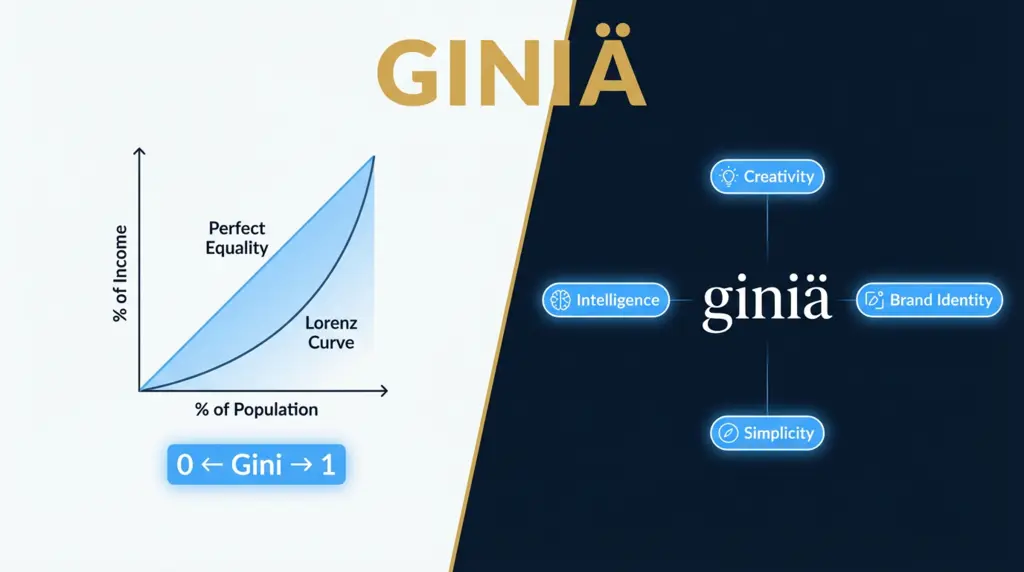
You searched “giniä” and landed on six different articles that each gave you a completely different answer. One told you it’s an economics statistic. Another said it’s a branding philosophy. A third called it a symbol of creative intelligence. A fourth linked it to Finnish grammar.
All of them are partially right. None of them told you the full picture. And that’s exactly why 33,100 people per month are still searching.
Here’s the honest answer upfront: Giniä is not one single thing. It carries two distinct, legitimate meanings that exist in completely separate contexts — and confusing them is the root of every unsatisfying article you’ve read so far. This guide maps both meanings clearly, explains where each one applies, and gives you the tools to understand which one matters for your specific situation.
Giniä defined (both meanings): In economics and social science, giniä refers to the Gini coefficient — a statistical measure of income or wealth inequality, developed in 1912 by Italian statistician Corrado Gini, scaled from 0 (perfect equality) to 1 (perfect inequality). In modern branding and digital culture, giniä is a coined term used as a brand identity, design philosophy, or conceptual label associated with simplicity, intelligence, and creative purpose.
These two meanings do not overlap. Which one applies depends entirely on where you encountered the word. Here’s how to tell them apart — and why each one matters.
Meaning 1: Giniä as the Gini Coefficient
This is the older, more academically significant meaning — and the one most likely to appear in news coverage, policy discussions, and economic research.
What the Gini Coefficient Actually Measures
The Gini coefficient quantifies how evenly income or wealth is distributed within a population. It compares actual distribution against a hypothetical perfectly equal one, then produces a single number that summarizes the entire gap.
The concept was developed by Corrado Gini, an Italian statistician, in his 1912 paper Variability and Mutability. Over the following century, it became the single most widely used tool for measuring economic inequality across countries, used by the World Bank, the United Nations Development Programme (UNDP), the OECD, and every major national statistics agency.
The Scale: What the Numbers Mean
| Gini Value | What It Means | Real-World Example (2025) |
| 0.00–0.25 | Very low inequality | Slovenia (0.24), Slovakia (0.23) |
| 0.25–0.35 | Moderate inequality | Germany (0.31), Canada (0.33) |
| 0.35–0.45 | High inequality | United States (0.39), China (0.38) |
| 0.45–0.60 | Very high inequality | Brazil (0.52), Mexico (0.45) |
| 0.60–1.00 | Extreme inequality | South Africa (0.63) |
The United States currently sits at approximately 0.39, according to the U.S. Census Bureau’s 2025 income inequality report — making it one of the most unequal developed economies in the world. That number has risen from 0.35 in 1985, a 40-year trend that policymakers across both parties cite when discussing tax reform, minimum wage legislation, and social safety net spending.
How It’s Actually Calculated
The Gini coefficient is derived from the Lorenz curve — a graph that plots the cumulative percentage of total income earned against the cumulative percentage of the population, from poorest to richest.
If income were perfectly equal, the Lorenz curve would form a straight 45-degree diagonal line. In reality, it curves below that line. The Gini coefficient is the ratio of the area between the diagonal and the actual Lorenz curve, divided by the total area under the diagonal.
A larger gap between the diagonal and the curve = a higher Gini value = more inequality.
Here’s what this means practically: If the bottom 50% of earners in a country receive only 10% of total income, the Lorenz curve bows sharply away from the equality line. If the bottom 50% receive 40% of income, the curve stays much closer. Giniä captures that entire distribution in a single number.
Why Giniä Matters for Real Policy Decisions
Governments don’t track Gini values out of academic curiosity. They use it to:
- Design tax systems: Progressive taxation is calibrated partly based on Gini trends. When inequality rises, pressure builds for higher marginal rates on top earners.
- Evaluate welfare programs: If a country’s Gini falls after introducing a new social transfer program, that’s evidence the program is working as intended.
- Access international development funding: The World Bank and IMF incorporate Gini data into country assessments for loans and aid eligibility.
- Benchmark against peers: A U.S. Gini of 0.39 versus Germany’s 0.31 is a concrete, comparable data point that shapes immigration, trade, and development policy debates.
“The Gini coefficient remains the most widely used summary statistic for income distribution, despite its limitations. No single number can capture the full complexity of inequality, but none captures it more efficiently.” — Based on World Bank Inequality and Shared Prosperity Report, 2025.
The Honest Limitations of Giniä
Every serious source on this topic acknowledges what the Gini coefficient cannot show. This is where most articles fall short.
It doesn’t distinguish the source of inequality. A Gini of 0.40 could reflect extreme poverty at the bottom or extreme wealth concentration at the top — or both. The same number looks very different in context.
It doesn’t capture non-income wealth. Home equity, retirement accounts, inheritance, and access to credit are not always reflected in income-based Gini calculations. Wealth Gini values are typically 15–25 points higher than income Gini values for the same country.
It’s not comparable across all datasets. Different organizations calculate Gini using different income definitions — pre-tax, post-tax, including benefits, excluding benefits. Comparisons between countries require confirming methodology alignment first.
Complementary measures that address these gaps include the Palma Ratio (top 10% income share divided by bottom 40%), the Atkinson Index, and the Human Development Index (HDI), all published annually by the UNDP.
Meaning 2: Giniä as a Modern Brand and Design Concept
This is the newer, culturally emergent meaning — and the one most likely to appear if you encountered giniä in a startup context, a design discussion, a digital product, or a creative community.
Where This Meaning Comes From
Giniä in this context is a coined term — deliberately constructed rather than inherited from an established language. The umlaut (ä) is not accidental. It signals European aesthetic influence, gives the word a distinctive visual fingerprint in search results, and creates a memorable spelling that stands apart in competitive naming environments.
Phonetically, giniä resonates with “genius” — a deliberate association that positions it in the space of intelligence, creativity, and purposeful thinking. This makes it attractive to brands, creatives, and digital communities that want a name that sounds like an idea rather than a product.
What Giniä Represents in This Context
When used as a brand or design concept, giniä clusters around three consistent values across its observed usage:
Simplicity over complexity. Products and services branded around giniä consistently emphasize reducing cognitive load — fewer steps, clearer interfaces, less friction. This aligns with established UX research from the Nielsen Norman Group, which shows that simplicity is the single strongest driver of user adoption for digital tools.
Intelligence as a design principle. The genius phonetic association isn’t incidental — it reflects a positioning around smart, purposeful design rather than feature-heavy complexity. The idea is that a truly intelligent product does more with less.
Adaptive identity. Unlike brand names tied to a single product category, giniä is intentionally flexible. It can represent a technology startup, a wellness brand, a design studio, or a creative collective without losing coherence. That flexibility is a deliberate feature of the naming choice, not a bug.
The Honest Limitation Here Too
Not every use of giniä in the branding context is backed by actual substance. Because the term has no formal definition, it can be applied to almost anything — and sometimes is, without meaningful differentiation. The shopthefamilyroost.com analysis of giniä correctly identifies this risk: over-branding without real functionality behind it erodes credibility quickly.
If you encounter a product, service, or platform using the giniä label, evaluate it the same way you’d evaluate any other brand claim: look at what it actually does, who built it, whether users report real outcomes, and whether the simplicity promise is real or cosmetic.
Which Meaning Applies to Your Search?
This is the question every existing article fails to answer directly. Here’s a simple framework:
| If you found “giniä” in… | It almost certainly means… |
| An economics article, policy report, or news story | Gini coefficient — income/wealth inequality measure |
| A World Bank, UN, or OECD publication | Gini coefficient — statistical measure |
| A startup pitch, product name, or design blog | Modern brand/concept — simplicity and creative identity |
| A Finnish language context | Grammatical form of a Finnish word (unrelated to both above) |
| A social media creative community | Modern coined concept — brand identity usage |
| A government statistics report | Gini coefficient — economic inequality data |
Sound familiar? Use the context where you first saw the word as your primary guide. When in doubt, the economic meaning is older, more established, and far more frequently the intended one in serious written content.
3 Mistakes People Make When Researching Giniä
Mistake #1: Assuming it’s only one thing The single biggest mistake. Multiple search intent types exist for this term, and most articles pick one angle and ignore the rest. If an article opens without acknowledging the dual meaning, treat its conclusions with appropriate skepticism.
Mistake #2: Conflating giniä with poverty High Gini values measure inequality, not poverty. A country can have high average incomes and a high Gini simultaneously — meaning the wealthy are very wealthy but the poor are not necessarily destitute by global standards. Conversely, a low-income country can have a low Gini if everyone earns similarly little. They measure different things.
Mistake #3: Taking brand-context giniä at face value When giniä appears as a brand or concept label, it carries no inherent quality guarantee. The term’s appeal is its aesthetic and phonetic associations — not a certified standard. Always evaluate the substance behind the label independently.
Frequently Asked Questions About Giniä
What is giniä in simple terms?
Giniä has two meanings. In economics, it refers to the Gini coefficient — a number between 0 and 1 that measures income or wealth inequality in a society. In modern branding and digital culture, it’s a coined term representing a design philosophy built around simplicity, intelligence, and creative identity. Which meaning applies depends on the context where you encountered it.
Is giniä the same as the Gini coefficient?
In economics and statistics, yes — the terms are used interchangeably. The Gini coefficient was developed by Italian statistician Corrado Gini in 1912 and remains the world’s standard tool for measuring income distribution inequality. In non-economic contexts, giniä refers to something entirely different.
What does a Gini score of 0.39 mean for the U.S.?
The U.S. Gini coefficient of approximately 0.39 (U.S. Census Bureau, 2025) means American income distribution sits between moderate and high inequality by global standards. It ranks significantly higher than most Western European countries (Germany at 0.31, Denmark at 0.28) and reflects a long-term trend of rising inequality since the 1980s.
Is giniä related to Finnish?
The word form “giniä” does appear in Finnish as a grammatical case form (partitive case) of certain nouns, but this is coincidental and unrelated to either the economic meaning or the modern branding usage. Finnish readers encountering giniä in a non-Finnish text should assume the economic or branding context applies.
Can a country’s Gini value change?
Yes — and it does, often significantly over decades. Brazil reduced its Gini from 0.59 in 2003 to 0.49 by 2015 through sustained social transfer programs. The U.S. Gini rose from 0.35 in 1985 to 0.39 by 2025. These are not static measurements — they respond directly to tax policy, wage legislation, social programs, and economic shocks.
Why does giniä have an umlaut (ä)?
In the branding context, the umlaut is a deliberate stylistic choice. It creates visual distinction, signals European design influence, produces a unique search fingerprint, and gives the word a refined aesthetic tone that plain “ginia” lacks. It’s a naming strategy, not a linguistic requirement.
Is giniä a good or bad thing when it’s high?
In economic terms, a high giniä (closer to 1) indicates greater inequality — which most economists associate with reduced social mobility, lower trust in institutions, and higher risk of social instability, based on research from the IMF and the World Bank. However, whether it’s “bad” depends on political values. Some argue inequality reflects economic dynamism; others argue it undermines equal opportunity. The number itself is descriptive, not prescriptive.
Key Takeaways
You now know what every existing article about giniä gets wrong: the term has two distinct, legitimate meanings that exist in separate contexts and serve completely different purposes. The economic meaning — the Gini coefficient — is older, more precisely defined, and tied to one of the most important measurement tools in global policy. The modern branding meaning is newer, more flexible, and tied to design culture and digital identity.
The U.S. Gini of 0.39 is a concrete, consequential number. The branding use of giniä is a naming strategy whose value depends entirely on the substance behind it.
Your Next Steps:
- Right now (2 minutes): Identify which context you originally encountered giniä in. That single step resolves 90% of the confusion around this term.
- This week: If the economic meaning applies to you, bookmark the World Bank’s Gini data portal (data.worldbank.org) for country-by-country comparisons updated annually.
- Ongoing: If the branding context is relevant, evaluate any giniä-labeled product or service using the four-step framework above: actual function, user outcomes, real simplicity, transparent documentation.
The confusion around giniä isn’t accidental — it reflects a genuine collision between an old, well-established technical term and a new, fluid brand language. Now you know how to navigate both.
