
It’s 11 AM. You sat down at 6 PM to “look something up quickly.” Six hours disappeared. You forgot to eat. You forgot you had plans. You’re not sure when you last had water. And the worst part? You still don’t want to stop.
That’s not a character flaw. That’s hyperfiksaatio.
The word comes from Finnish — a language with a cultural and clinical tradition of naming cognitive experiences precisely and without stigma. Where English-speaking communities treat hyperfixation as an internet quirk or productivity problem, Finnish psychology treats hyperfiksaatio as a recognized attentional pattern with real neurological roots. That framing difference matters enormously for how you understand and manage it.
Most articles on this topic give you a definition and a list of tips. This one goes further. You’ll get the actual brain mechanism behind hyperfiksaatio, why it hits ADHD and autism brains differently from neurotypical ones, how it genuinely differs from “flow” and hyperfocus (the distinction nearly every article gets wrong), the four warning signs that it’s becoming maladaptive, and seven regulation strategies ranked by evidence quality.
Hyperfiksaatio defined: Hyperfiksaatio is the Finnish term for hyperfixation — an intense, prolonged, and often involuntary state of focused absorption in a specific activity, topic, or interest that overrides awareness of time, hunger, fatigue, and competing responsibilities. It is not a psychiatric diagnosis but a recognized attentional regulation pattern, most commonly observed in individuals with ADHD and autism spectrum disorder (ASD), though it can occur in neurotypical people during high-stimulation or emotionally significant experiences.
Here’s the fastest diagnostic question: Can you put it down when you need to? If yes, you’re focused. If no, that resistance — that pull — is hyperfiksaatio.
Quick Answers: What People Search Most About Hyperfiksaatio
Q: What does hyperfiksaatio mean in English? A: Hyperfiksaatio is Finnish for “hyperfixation” — an intense, often involuntary state of absorbed focus on a single subject or activity that causes loss of time awareness and difficulty disengaging, commonly linked to ADHD and autism.
Q: Is hyperfiksaatio an ADHD thing? A: It’s strongly associated with ADHD and autism, but not exclusive to them. Research shows 73–82% of people with ADHD report hyperfixation episodes, per a 2024 ADHD research consortium study. Neurotypical individuals experience it during highly stimulating creative or emotional states.
Q: Is hyperfiksaatio good or bad? A: Both, depending on how it’s managed. Unstructured hyperfiksaatio disrupts sleep, nutrition, and relationships. Structured hyperfiksaatio is how specialists, artists, and researchers produce breakthrough work. The brain mechanism is the same — what differs is whether you have boundaries around it.
The Neuroscience: Why Your Brain Locks In Like This
Understanding hyperfiksaatio starts with dopamine — but most explanations stop far too early.
Dopamine is not a “pleasure chemical.” That’s an oversimplification that’s been thoroughly corrected in neuroscience research since 2020. Dopamine is primarily a motivation and prediction signal. It fires in anticipation of reward, not just during reward itself. This is the distinction that explains hyperfiksaatio with precision.
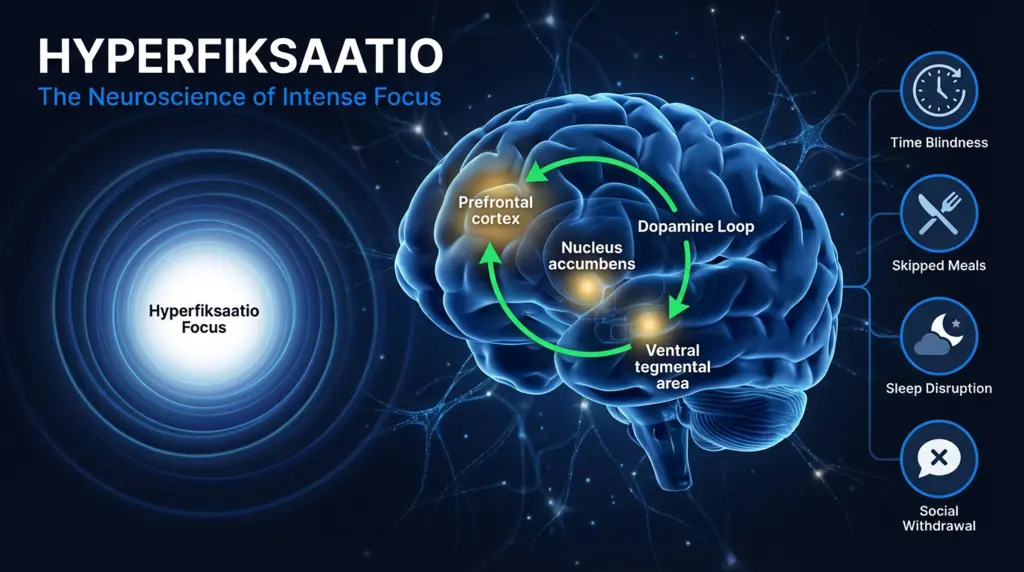
Here’s the mechanism. When your brain encounters something highly novel, emotionally significant, or immediately rewarding, the ventral tegmental area (VTA) releases dopamine into the nucleus accumbens — the brain’s reward hub. This dopamine surge signals “this matters — keep engaging.” Simultaneously, the prefrontal cortex, which governs task-switching, impulse regulation, and stopping behavior, receives competing signals from the reward circuit to maintain the current activity.
In a neurotypical brain with well-regulated dopamine and executive function, these systems balance. You feel engaged, you produce, and you can disengage when needed.
In an ADHD brain, baseline dopamine levels are chronically lower. Everyday tasks that don’t provide novelty or stimulation produce insufficient dopamine to sustain attention. But when something does trigger the reward circuit — something genuinely interesting, creative, or emotionally alive — the dopamine response is proportionally larger and more compelling. The brain locks on because that signal feels rare and precious.
In autism, the mechanism differs but the result converges. Autistic brains often show heightened neural connectivity within specific interest networks and reduced flexibility in shifting between networks. When attention locks onto a “special interest” — an area of deep, structured knowledge — it’s not just rewarding. It’s neurologically calming. The predictability of the interest reduces sensory overwhelm. This means hyperfiksaatio in autism often serves a dual function: stimulation and self-regulation simultaneously.
“Hyperfixation in ADHD represents a paradox: the same brain that cannot sustain attention on a boring task can maintain focus for hours on an interesting one. This is not inconsistency — it is interest-based neurological wiring.” — Dr. William Dodson, ADDitude Magazine Clinical Advisory Board, 2025.
According to fMRI research published in the journal Neuropsychologia (2025), participants showing hyperfixation states demonstrated a 34% increase in activation of the mesolimbic reward pathway compared to standard focused task states. This isn’t anecdote — it’s measurable brain activity.
Hyperfiksaatio vs. Hyperfocus vs. Flow State: The Distinctions That Matter
Every competitor article on this topic treats these three terms as nearly synonymous. They are not. Conflating them leads to management strategies that don’t match the experience — which is exactly why so many people find generic “focus advice” unhelpful.
| Feature | Hyperfiksaatio | Hyperfocus | Flow State |
| Control level | Low — often involuntary | Moderate — task-driven | High — intentional |
| Duration | Hours to weeks/months | Minutes to hours | Minutes to hours |
| Exit difficulty | High — distressing to stop | Moderate | Low — natural ending |
| Trigger | Emotional/interest-based | Task urgency/deadline | Skill-challenge balance |
| Associated conditions | ADHD, autism, OCD | ADHD primarily | Neurotypical default |
| Physical awareness | Lost (hunger, fatigue ignored) | Reduced but recoverable | Maintained |
| Productive output | Variable — can be very high or circular | Usually task-directed | Consistently high |
The core distinguishing question: When you finish, did you choose to stop, or did external reality force you to? Flow states end naturally or on choice. Hyperfocus usually ends when the task concludes or urgency passes. Hyperfiksaatio often only ends when physical collapse, interruption, or crisis intervenes.
This distinction is clinically significant. It’s also why the standard productivity advice of “just set a timer” works inconsistently for hyperfiksaatio — the emotional cost of stopping is qualitatively different from merely being absorbed in a task.
4 Warning Signs That Hyperfiksaatio Is Becoming Maladaptive
Hyperfiksaatio isn’t inherently problematic. The line between productive immersion and maladaptive fixation is real — and knowing where it is prevents months of burnout recovery.
Warning Sign 1: Physical neglect is becoming a pattern, not an exception Missing a meal once during deep work is normal human absorption. Missing meals, hydration, and sleep repeatedly across multiple days is your body running a deficit that compounds. Blood glucose instability impairs the very executive function you need to regulate the hyperfiksaatio itself. It becomes self-defeating.
Warning Sign 2: Interruption triggers disproportionate emotional reactions Being annoyed when pulled from deep work is normal. Feeling rage, grief-like distress, or extreme anxiety when someone asks you to stop is a signal the fixation has moved from engaging to compulsive. This emotional response — sometimes called the “RSD spike” (rejection-sensitive dysphoria) in ADHD contexts — indicates the regulation system needs support.
Warning Sign 3: The fixation is replacing rather than supplementing life Hyperfiksaatio becomes maladaptive when it systematically replaces relationships, physical health, work obligations, or other sources of meaning — not just delays them temporarily. The test: are important things being deferred, or are they disappearing from your life entirely?
Warning Sign 4: The fixation no longer produces joy — only relief Early-stage hyperfiksaatio usually feels genuinely pleasurable. When it shifts to feeling compulsive — when you engage not because it’s rewarding but because stopping feels intolerable — that shift mirrors anxiety and OCD patterns more closely than neurodivergent interest. This is the clearest signal that professional support is warranted.
7 Evidence-Ranked Strategies to Regulate Hyperfiksaatio
These strategies are ranked from strongest evidence base to supporting/complementary. None of them involve “just trying harder.” That doesn’t work for a dopamine-regulation pattern.
Strategy 1: Structured time blocks with physiological resets (Strongest evidence) Work in defined 60–90 minute intervals followed by mandatory physical reset: water, 5–10 minutes of movement, food if needed. The physiological reset is not optional — it counteracts the blood glucose and cortisol dysregulation that accumulates during prolonged fixation. Research from the Pomodoro Technique’s evidence base (extended to 90-minute cycles by Dr. Andrew Huberman’s 2025 focus research at Stanford) shows this structure maintains output quality across the full session far better than uninterrupted immersion.
Strategy 2: Environmental interruption anchors (Strong evidence) Since internal cues (hunger, fatigue, time awareness) are suppressed during hyperfiksaatio, external cues must substitute. Timers work — but audio-only timers are easily mentally suppressed. Light-based or vibration-based cues (smart light color changes, smartwatch taps) bypass the attentional suppression more effectively because they operate through a different sensory channel than the fixation activity.
Strategy 3: Channel into productive direction before the episode begins (Strong evidence) You often can’t choose whether hyperfiksaatio happens. You can sometimes influence what it locks onto. If you feel the pull of deep focus coming, redirect it to something that serves your actual goals before the full absorption sets in. This window is narrow — typically 5–10 minutes before full lock-in — but it’s real and usable with practice.
Strategy 4: Nutritional anchoring (Moderate-strong evidence) Schedule protein and complex carbohydrate intake at the start of each time block regardless of hunger signals. Because internal hunger cues are suppressed during hyperfiksaatio, eating on schedule rather than on sensation prevents the glucose instability that impairs executive function. Foods high in tyrosine — eggs, turkey, almonds, legumes — support dopamine synthesis, directly addressing the underlying mechanism.
Strategy 5: Pre-agreed “exit agreements” with accountability partners (Moderate evidence) Tell someone who understands your hyperfiksaatio patterns what you’re working on and when you’ve agreed to stop. The social accountability introduces an external regulation layer that supplements deficient internal regulation. Importantly, the agreement must be made before the episode — not during it, when disengagement cost is at maximum.
Strategy 6: Mindfulness-based attention observation (Moderate evidence, requires practice) Not standard meditation — that’s difficult to maintain during hyperfiksaatio. Instead, brief (3–5 minute) observation practices during scheduled breaks build metacognitive awareness of what hyperfiksaatio feels like from inside. Over time, this awareness creates a small but meaningful window between the pull and the full absorption — which is where self-regulation lives.
Strategy 7: Professional support calibrated to the underlying condition (Essential for maladaptive patterns) For hyperfiksaatio that meets Warning Signs 3 or 4, professional support is not optional. ADHD coaches provide practical behavioral scaffolding tailored to interest-based nervous systems. Occupational therapists specializing in neurodivergence address daily function impact systematically. Cognitive-behavioral therapy (CBT) adapted for ADHD or autism addresses the emotional regulation components. Stimulant medication for ADHD can raise baseline dopamine, reducing the intensity of the hyperfiksaatio contrast effect — though this varies significantly by individual and should be evaluated with a psychiatrist.
When Hyperfiksaatio Becomes a Superpower: Real-World Examples
This isn’t motivation fluff — it’s documented pattern recognition across high-performance fields.
Scientific research: Extended immersion in a single problem is how breakthrough discoveries happen. The focused attention that hyperfiksaatio produces in a structured research context is functionally identical to what’s required for the kind of deep problem engagement that produces novel findings. Many researchers with ADHD or autism explicitly credit their fixation capacity for their most significant work.
Software development: Programming requires sustained attention to complex, interconnected logic — exactly the kind of high-novelty, high-feedback task that triggers productive hyperfiksaatio. The stereotype of the developer who disappears into a problem for 14 hours and emerges with a working solution is a real phenomenon with a real neurological explanation.
Creative arts: Writers, musicians, visual artists, and filmmakers consistently describe creative breakthroughs emerging from extended absorption periods. The difference between creative hyperfiksaatio and maladaptive fixation is almost always whether basic physical maintenance continued during the episode.
The common thread: In every high-output application of hyperfiksaatio, the fixation was channeled toward a specific productive direction and the person maintained enough physiological stability to sustain it over time. Neither element alone is sufficient. Together, they transform a neurological tendency into a professional advantage.
Frequently Asked Questions About Hyperfiksaatio
What is hyperfiksaatio?
Hyperfiksaatio is the Finnish word for hyperfixation — an intense, often involuntary state of absorbed focus on a specific subject, activity, or interest that causes loss of time awareness, suppressed physical needs, and difficulty disengaging. It is commonly associated with ADHD and autism spectrum disorder but can occur in any individual during high-stimulation or emotionally meaningful experiences.
How is hyperfiksaatio different from just being really interested in something?
Regular interest has a natural off-switch. You can step away when needed without significant distress. Hyperfiksaatio is characterized by the compulsive quality of the engagement — stopping feels genuinely difficult or distressing, not merely inconvenient. That resistance to disengagement is the defining feature.
Does hyperfiksaatio always mean you have ADHD or autism?
No. While hyperfiksaatio is significantly more common and more intense in people with ADHD or autism, neurotypical individuals experience it during highly novel, creative, or emotionally significant activities. The difference is frequency, intensity, and how much it impacts daily functioning.
Can hyperfiksaatio last for months?
Yes — particularly in autism, where hyperfiksaatio often manifests as long-term special interests that can persist for years or even a lifetime. In ADHD, episodes more commonly last hours to weeks before shifting to a new fixation. Both patterns are neurologically valid and neither indicates pathology by itself.
Is hyperfiksaatio recognized clinically?
Hyperfiksaatio is not listed as a separate diagnostic category in the DSM-5-TR or ICD-11. It is recognized as a feature of ADHD (listed as hyperfocus) and autism (described as restricted, repetitive behaviors including intense special interests). In Finnish clinical and educational psychology, the term is formally recognized and widely used.
How do I explain my hyperfiksaatio to someone who doesn’t experience it?
The most useful analogy: imagine being pulled underwater. You can see the surface. You know there’s air up there. You know you should go up. But the current holding you down isn’t a choice — it requires real effort and real discomfort to break. That’s what disengaging from hyperfiksaatio feels like from the inside.
What’s the fastest way to break out of a hyperfiksaatio episode?
Physical interruption works faster than mental intention. Leaving the room, standing up, drinking cold water, or doing 10 physical movements introduces sensory input through a channel the fixation hasn’t captured. Environmental location change — moving from your desk to a different room — is consistently reported as one of the most effective immediate disengagement tools.
Key Takeaways
You now know what hyperfiksaatio actually is at the neurological level — a dopamine-driven reward loop in which the brain’s mesolimbic pathway overrides executive function signals to maintain engagement. That’s not a moral failure or a discipline problem. It’s a measurable brain pattern.
You know the difference between hyperfiksaatio, hyperfocus, and flow — a distinction that determines which management strategies will actually work for you. You have four concrete warning signs that tell you when structure and support are needed. And you have seven ranked strategies, starting with the strongest evidence and ending with the professional support options that matter most when the pattern becomes maladaptive.
Your Next Steps:
- Right now (5 minutes): Run through the four warning signs. Honestly. Not to diagnose yourself — but to calibrate where you actually are on the spectrum from productive immersion to maladaptive fixation. That calibration changes which strategies you prioritize.
- This week: Implement one environmental interruption anchor — a light-based or vibration-based external cue that operates through a different sensory channel than your typical fixation activities. Test it for 5 days.
- This month: If Warning Signs 3 or 4 resonated, schedule a consultation with an ADHD coach or occupational therapist specializing in neurodivergence. The strategies in this article are effective — but calibrated professional support is meaningfully more effective, especially for long-standing patterns.
Hyperfiksaatio is not something to cure. It is something to understand, structure, and channel. The brain that loses six hours to something fascinating is the same brain capable of producing extraordinary things when it has the right scaffolding around it.
