
As software development cycles become shorter and customer expectations rise, testing teams face increasing pressure to deliver high-quality products at rapid speed. Manual testing alone can no longer keep up with today’s agile and DevOps environments, and traditional automation often demands technical skills that many QA or business professionals simply don’t have.
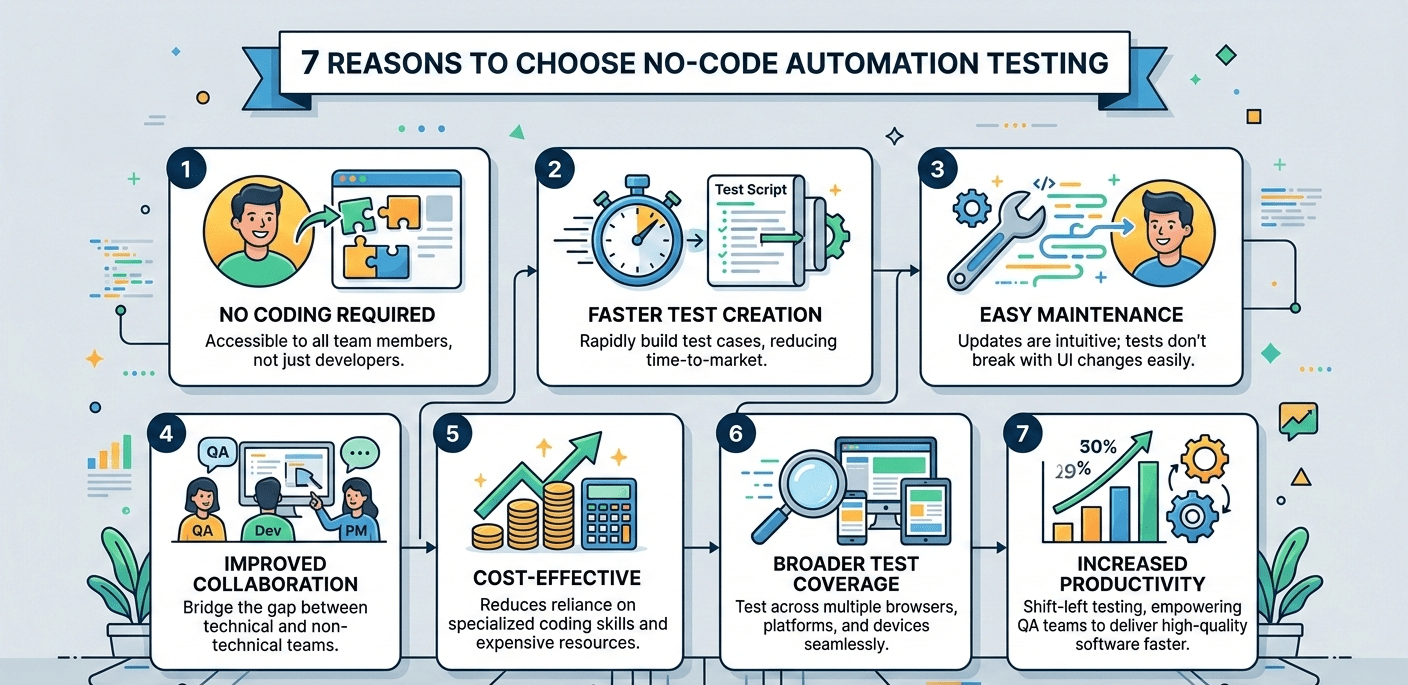
That’s where no-code automation testing comes in. It removes the need for complex scripting, allowing anyone to build and manage automated tests using simple, intuitive interfaces. This approach bridges the gap between technical and non-technical teams, accelerates delivery, and ensures consistent quality across every release. In this article, we’ll explore seven key reasons why organizations are turning to no-code automation testing to stay competitive and efficient.
What is No-Code Automation Testing?
No-code automation testing is a method of creating and running automated tests without writing any programming scripts. Instead of coding, users can describe test actions in plain English or use intuitive drag-and-drop interfaces. This makes test automation accessible to all members of a software team, including QA specialists, business analysts, and product owners.
Unlike traditional or even low-code solutions, no-code testing tools completely eliminate the need for coding knowledge. They handle complex logic, UI interactions, and validations automatically. This approach not only simplifies automation but also accelerates delivery timelines and improves collaboration among cross-functional teams.
1. Faster Test Creation and Execution
No-code automation testing dramatically speeds up test creation and execution. Traditional test scripts often take hours or days to write, especially for complex workflows. With intuitive interfaces and natural-language test design, teams can create comprehensive test suites in minutes rather than days.
These tools also integrate with continuous integration systems, allowing automated tests to run instantly with every new build. The result is faster feedback, reduced bottlenecks, and shorter release cycles without compromising software quality.
2. Empowering Non-Technical Teams
No-code automation empowers everyone in the organization to contribute to testing. Business analysts, QA specialists, and product managers can create and maintain automated tests without needing programming skills. This inclusive approach enables testing to become a shared responsibility rather than a specialized task limited to developers.
When non-technical team members can participate, collaboration improves across departments. Tests can be written based on real user scenarios, ensuring broader coverage and stronger alignment between technical and business objectives.
3. Lower Maintenance Costs
Traditional test automation frameworks often require constant maintenance because even small UI changes can break multiple test cases. No-code automation platforms handle this more intelligently by adapting automatically to changes in layout, element names, or workflows, which significantly reduces maintenance efforts.
This adaptability saves valuable time and resources. Instead of spending hours fixing broken tests, QA teams can focus on improving coverage, analyzing results, and enhancing overall testing efficiency, resulting in lower long-term costs.
4. Increased Test Coverage
No-code automation makes it easier and faster to create large volumes of tests, naturally leading to greater coverage. Teams can automate repetitive tests, regression checks, and end-to-end workflows that would otherwise take too long to complete manually.
If you’re exploring automation testing tools without coding, this is where they truly excel. By reducing technical barriers, teams can build comprehensive test suites that cover every critical user flow, ensuring a more stable and reliable product experience.
5. Seamless Integration and Scalability
Modern no-code automation platforms integrate smoothly with popular tools such as Jenkins, Jira, Slack, and CI/CD pipelines. This seamless connectivity makes it easy to fit automation into existing workflows, ensuring that testing remains consistent and continuous across development stages.
Scalability is another key advantage. Whether your team needs to run tests across different browsers, devices, or environments, no-code solutions can easily handle the load. This flexibility allows your testing strategy to grow alongside your product and organization.
6. Improved Collaboration and Transparency
No-code test cases are written in plain, human-readable language, making them easy for everyone to understand. Developers, testers, and business stakeholders can all review and validate test scenarios without interpreting complex scripts. This clarity improves communication and ensures that everyone stays aligned on what is being tested and why.
With shared visibility into test results, teams can identify gaps and make informed decisions quickly. The transparency also fosters accountability, leading to stronger collaboration between QA and other departments.
7. Faster ROI and Continuous Improvement
No-code automation delivers a faster return on investment compared to traditional testing. Because the learning curve is minimal and maintenance is low, teams can start seeing results quickly. The time saved in creating and maintaining tests directly translates into shorter release cycles and reduced costs.
Additionally, modern no-code tools often include AI-assisted capabilities that make test creation smarter over time. As these tools evolve, organizations benefit from ongoing improvements in speed, accuracy, and scalability, ensuring sustained value from their automation efforts.
Conclusion
No-code automation testing is redefining how teams approach software quality. It simplifies test creation, minimizes maintenance, and allows both technical and non-technical users to contribute effectively. With its ability to enhance speed, collaboration, and accuracy, it has become an essential part of modern development processes.
By adopting no-code automation, organizations can achieve faster releases, better coverage, and higher confidence in every deployment. It is a practical, future-ready approach that empowers teams to deliver exceptional software at scale.
