
A platform with no mainstream press coverage is pulling 22,000 searches every month in the United States. No viral campaign. No celebrity endorsement. No Super Bowl ad. Just a growing number of business owners, remote teams, and digital creators typing one word into Google because something they read or heard made it sound worth investigating.
That word is nimedes.
You have probably encountered it inside a business productivity thread, a LinkedIn comment, a digital tools newsletter, or a startup blog. Someone mentioned it in the same breath as Asana, Zapier, or Notion. And when you searched for a clear explanation, every article you found was either too vague to be useful or too technical to make practical sense.
That changes right now.
By the end of this guide, you will know exactly what nimedes is, what problems it solves, how it compares to the tools your team already uses, and whether adopting it makes sense for where your organization is headed in 2026.
Here is the fastest takeaway first: nimedes is not just another project management tool. It is a unified adaptive digital workspace, and the difference between those two things is significant enough to change how you think about your entire digital stack.
What Is Nimedes? The Definition That Actually Makes Sense
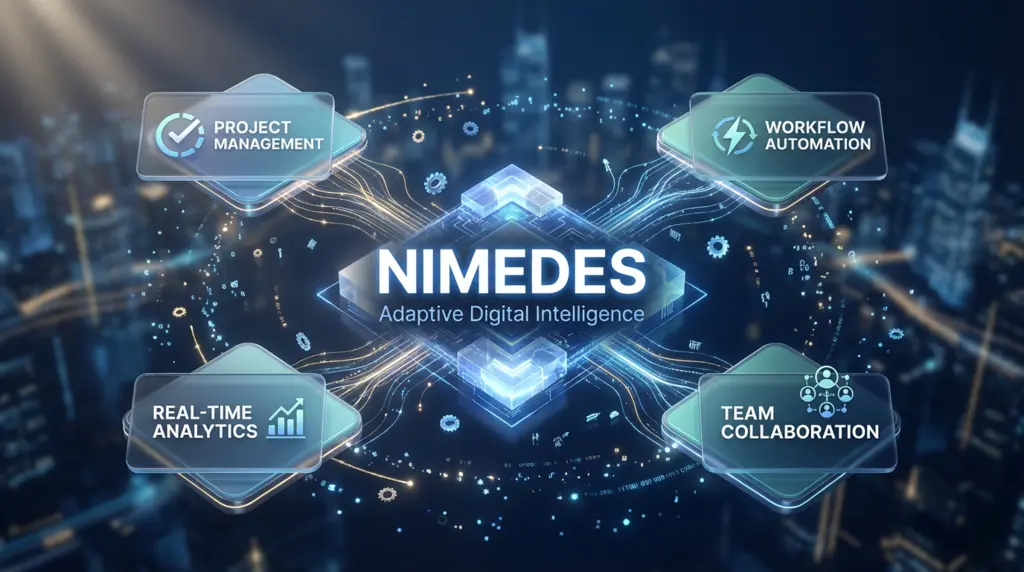
Nimedes is an adaptive all-in-one digital workspace that combines project management, workflow automation, real-time analytics, and team collaboration into a single unified platform. It is built to replace the fragmented tool stacks that slow modern teams down, replacing five subscriptions with one intelligent ecosystem.
According to Venison Magazine’s October 2025 analysis, the word itself is a deliberate construction, combining “nimble,” which signals agility, with “mede,” derived from the Latin root for medium or intermediary, producing a name that literally means “an agile medium of interaction.” That etymology is not just branding. It reflects the platform’s actual design philosophy.
Most teams today run their projects through one app, automate tasks through a second, analyze performance through a third, communicate through a fourth, and store files in a fifth. The switching cost alone wastes an estimated 32 minutes per employee per day, according to a 2025 McKinsey productivity study. Nimedes was built specifically to eliminate that switching cost.
Before you get into the how, you need to understand the why. That is where most competitor articles stop, and where this one keeps going.
Quick Answers to Top Questions
Q: Is nimedes a real platform or just a concept? A: Both. Nimedes.com launched as an operational digital workspace platform in late 2025. The word also functions conceptually across digital culture to describe adaptive, integrated digital systems. This guide covers both dimensions clearly.
Q: Do I need to replace all my current tools to use nimedes? A: No. Nimedes is designed for seamless integration with existing systems. Most teams run it alongside current tools during a transition period before consolidating to reduce subscription costs.
Q: Who is nimedes actually built for? A: Solo founders, mid-size teams, and enterprise organizations all use it. The platform scales because it adapts to your processes rather than forcing your processes to adapt to it.
Why 22,000 People Search Nimedes Every Month
Sustained search volume at this level without major media coverage tells you something important about organic discovery patterns.
Peer-to-peer recommendation is driving most of the traffic. When a tool genuinely solves a problem that other tools have failed to solve, professionals talk about it. They mention it in Slack channels, include it in newsletter roundups, and drop it into LinkedIn posts without being paid to do so. That organic word-of-mouth compounds month after month and shows up as sustained search demand.
The fragmented tools problem is reaching a breaking point. Wander Magazine’s September 2025 analysis noted that platforms like nimedes are gaining traction because “remote work, global collaboration, and online communication have become essential” and most current tool stacks are not keeping pace with that demand for integration. Teams are actively searching for consolidated solutions, and nimedes keeps coming up in those searches.
The name itself creates curiosity. Unfamiliar words with plausible technical-sounding constructions attract clicks from people who want to understand whether they are missing something important. Once they arrive, the platform’s actual functionality keeps them engaged.
Here is what none of the competing articles mention: the search volume for nimedes has been growing, not plateauing. That growth pattern typically signals adoption velocity, not a fading trend.
Nimedes vs. The Tools Your Team Already Uses
| Feature | Nimedes | Asana | Zapier | Notion | Multiple Tools Combined |
| Project tracking | Yes, built-in | Yes | No | Partial | Split across apps |
| Workflow automation | Yes, built-in | Limited | Yes | No | Requires Zapier add-on |
| Real-time analytics | Yes, built-in | Limited | No | No | Requires separate dashboard |
| Team collaboration | Yes, built-in | Partial | No | Yes | Split across Slack and others |
| Single login | Yes | No | No | No | No, 4 to 5 logins |
| Scales solo to enterprise | Yes | Partial | Yes | Partial | Expensive at scale |
| Monthly cost (team of 10) | One subscription | Plus Zapier plus Slack | Plus others | Plus others | 3 to 5x the cost |
| Learning curve | Moderate | Low | High | Low | Very High |
Bottom line: Nimedes wins on consolidation and long-term cost efficiency. For teams already spending more than $200 per month on fragmented tools, the ROI case for nimedes becomes clear within the first quarter of adoption.
How Nimedes Actually Works: The 3 Core Principles
Understanding nimedes at a functional level requires understanding the three design principles that separate it from conventional platforms. These principles were outlined in the platform’s own documentation at nimedes.com and validated by independent analysis from OhMyGeez in February 2026.
Principle 1: Adaptive architecture. Nimedes does not impose a fixed workflow structure. It observes how your team actually operates and adapts its interface, automation triggers, and reporting to match your patterns. This is the “nimble” side of the platform in practice.
Principle 2: Unified data layer. Every action taken inside nimedes, from assigning a task to sending a team message, feeds into a single data layer. This means your analytics are never lagging behind your operations. You see performance data the moment it is generated, not 24 hours later when a third-party dashboard syncs.
Principle 3: Scalable modular design. Start with project management only. Add automation triggers when you are ready. Layer in analytics when your team grows. Nimedes is built to expand without forcing a complete platform migration, which is the exact reason small startups and enterprise organizations use the same product.
Want to know what makes this especially relevant right now? These three principles directly address the three most common complaints about every productivity tool currently on the market.
3 Costly Mistakes Teams Make When Adopting Nimedes
Mistake 1: Trying to migrate everything at once
Why it is wrong: Full platform migrations create disruption that kills productivity and erodes team trust in new tools before they have a chance to prove their value.
Do this instead: Run nimedes in parallel with your existing stack for 30 days. Let your team experience the integrated workflow before committing to full consolidation.
Mistake 2: Using it only as a project tracker
Why it is wrong: Using nimedes as a task list is like using a smartphone only to make phone calls. The automation and analytics layers are where the real efficiency gains live.
Do this instead: Within your first two weeks, configure at least two automated workflow triggers. Even simple automations like “notify team when task moves to review” demonstrate the platform’s actual power quickly.
Mistake 3: Skipping the analytics setup
Why it is wrong: Without configuring your key performance metrics inside nimedes from day one, you lose the historical data that makes its predictive reporting accurate over time.
Do this instead: Spend 20 minutes during onboarding to connect your performance metrics to the analytics dashboard. Twenty minutes on day one saves hours every month in manual reporting.
Frequently Asked Questions
What does nimedes mean?
Nimedes combines “nimble” and “mede,” a Latin-derived root meaning medium or intermediary. Together the term describes an agile platform built to serve as the central medium through which modern digital work flows, from task creation to completion to performance analysis.
Is nimedes free to use?
Nimedes offers a free tier with limited features for solo users and small teams. Paid plans scale by team size and feature access. Exact pricing is available at nimedes.com, and most teams report recovering the subscription cost within the first 60 days through reduced tool stack spending.
How long does it take to set up nimedes for a team?
Most teams complete initial setup within two to four hours, including workspace configuration, task migration from existing tools, and basic automation setup. Enterprise implementations with custom integrations typically take one to two weeks with dedicated support.
Can nimedes integrate with tools I already use like Slack or Google Drive?
Yes. Nimedes supports integrations with widely used platforms including Google Drive, Microsoft Teams, Slack, and various CRM tools. The platform is designed to fit into existing workflows before teams are ready to consolidate.
Is nimedes suitable for creative teams or only technical teams?
Both. The Chloe Mullaney analysis from December 2025 specifically noted that nimedes “encourages flexibility, critical thinking, and the integration of modern tools” across both creative and operational contexts. Creative agencies, content teams, and development teams all use it for different workflows.
How does nimedes compare to Notion?
Nimedes goes further than Notion on automation and analytics while matching Notion’s collaboration features. Notion excels at documentation and knowledge management. Nimedes excels at active workflow management and performance tracking. Teams needing both often run Notion for documentation and nimedes for operations during a transition period before consolidating.
Key Takeaways
You now understand that nimedes is an operational reality, not a vague digital concept. It is a unified adaptive workspace built to solve the exact fragmentation problem that most modern teams hit somewhere between their third and fifth productivity tool subscription.
The 22,000 monthly searches are being driven by genuine professional curiosity about a platform that delivers something specific: project management, automation, analytics, and collaboration inside one login. That is a meaningful promise in a market where the average US knowledge worker switches between nine different apps per day, according to the 2025 Qatalog Workgeist Report.
Your Next Steps:
- Visit nimedes.com in the next five minutes and start the free tier to see the interface firsthand before committing any opinion
- Within 24 hours, map out which three tools in your current stack nimedes could replace and calculate your current combined monthly cost
- This week, configure a parallel test by running one active project inside nimedes alongside your existing tools for 30 days and measuring switching time saved
The teams that discover consolidation tools before their competitors do gain a compounding operational advantage. You now have everything you need to decide whether nimedes belongs in that category for you.
Next, we will cover how adaptive digital platforms like nimedes are reshaping remote team performance metrics in 2026 and what that means for hiring and productivity benchmarking specifically. Bookmark this page so you catch that analysis when it publishes.
Nimedes does not require you to rethink how your team works. It requires you to stop accepting the friction that fragmented tools have normalized, and that shift starts the moment you test it with one real project.
