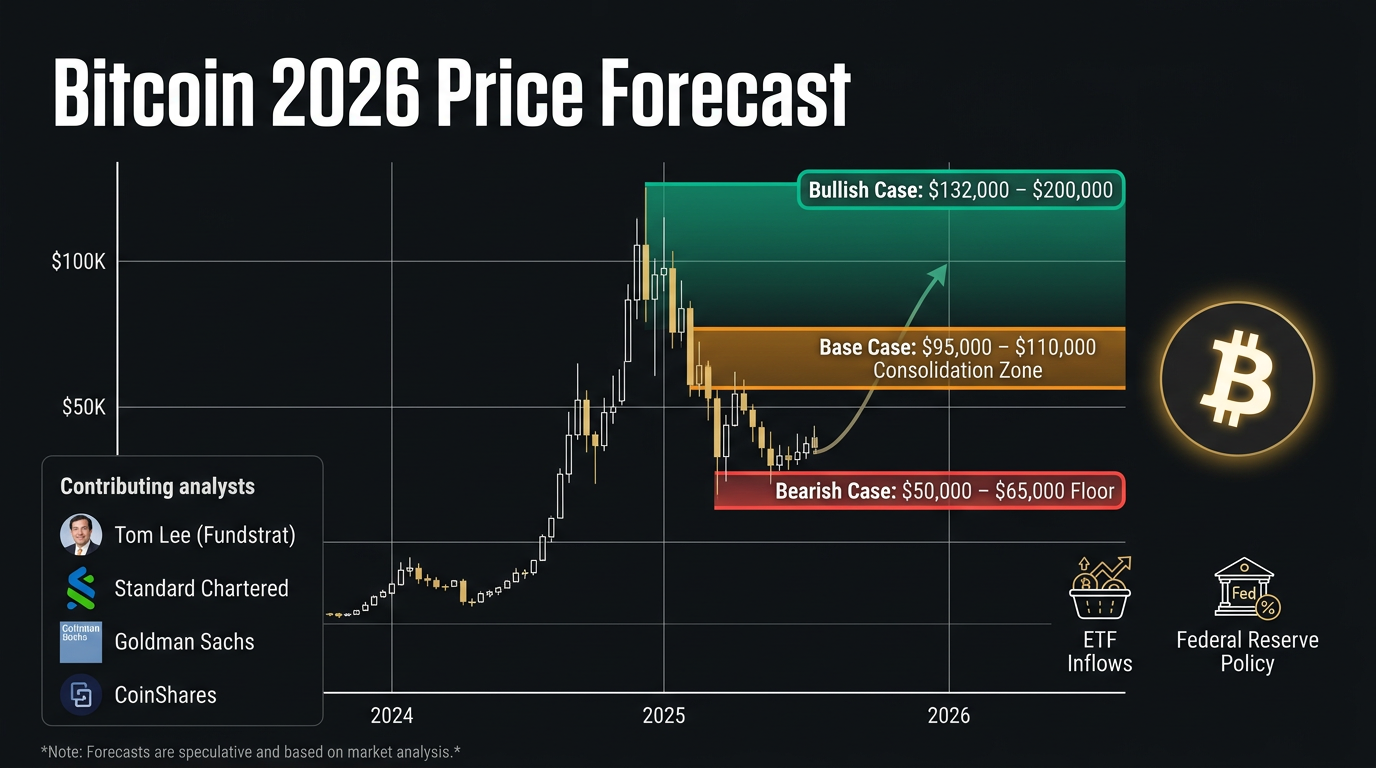
Bitcoin hit $126,000 in October 2025. By February 2026, it had crashed below $60,000. That’s a 40%+ drawdown in roughly four months—and it caught a lot of investors completely off-guard.
Here’s what nobody is saying clearly: the crash wasn’t random. A specific chain of events triggered it, and those same factors now determine whether Bitcoin recovers to $100K or grinds lower through the rest of 2026. Understanding those factors is the difference between making a data-backed decision and gambling on sentiment.
You’ve probably seen the headlines. Some analysts are calling for $200,000 before year-end. Others warn of a drop to $50,000 if macro conditions deteriorate. Both views have supporting evidence. That’s precisely why you need a framework—not a single price target, but three defined scenarios with the specific conditions that drive each one.
That’s what this guide delivers: current price context, the five forces shaping BTC in 2026, the full forecast range from bearish to bullish, and a plain-English breakdown of what to watch.
Quick Answers
Q: What is Bitcoin’s price right now in 2026? As of late March 2026, Bitcoin is trading near $70,000–$74,000, recovering from a February low of approximately $60,000 after geopolitical shock triggered a broad risk-off selloff.
Q: Will Bitcoin reach $100,000 again in 2026? Most analyst forecasts say yes—but conditionally. ETF inflows, Federal Reserve policy, and oil prices are the three variables that matter most. Four of five AI models surveyed by 24/7 Wall St. predicted BTC returns above $100K by year-end.
Q: What’s the biggest risk for Bitcoin in 2026? Sustained ETF outflows combined with no Fed rate cuts. If institutions keep reducing crypto exposure and the Fed stays locked at current rates, Bitcoin could retest the $52,000–$65,000 range.
Where Bitcoin Stands Right Now
Bitcoin started 2026 above $93,000 off the back of its October 2025 all-time high of $126,000. Then, in early February, the US and Israel struck Iran. Risk assets sold off globally. Bitcoin dropped from $93,000 to below $60,000 within weeks—one of the sharpest short-term drawdowns of this cycle.
As of late March, BTC has recovered to the low-to-mid $70,000 range, but faces a heavy resistance cluster there. The 200-day moving average trend remains upward sloping—a broadly bullish signal—but short-term momentum has cooled.
Here’s the context that matters: Bitcoin has held above $60,000 through a geopolitical conflict, months of extreme fear sentiment, and over $3.6 billion in ETF outflows. That’s meaningful structural support compared to previous cycles. The 2022 crash, for comparison, saw Bitcoin drop from $69,000 to $16,000—a full 77% drawdown. This cycle’s floor has held significantly higher.
But “higher floor than last cycle” is not the same as “recovery is guaranteed.” Four specific forces are now driving BTC’s path forward.
5 Forces Driving Bitcoin’s Price in 2026
1. Bitcoin ETF Flows — The Single Most Important Variable
Bitcoin spot ETFs launched in January 2024 and changed the market structure permanently. Institutional capital can now flow in and out of Bitcoin through traditional brokerage accounts, which means Bitcoin price now tracks institutional appetite more closely than retail sentiment.
Early January 2026 saw strong ETF inflows exceeding $1.2 billion. That reversed sharply in late January with nearly $1 billion in outflows as institutions reduced crypto exposure into the Iran conflict. The net effect: Bitcoin’s price is now more tightly correlated to institutional risk tolerance than at any previous point in its history.
What to watch: Sustained weekly ETF inflows above $500 million are broadly bullish. Consecutive weeks of outflows are the clearest early warning signal for further downside.
2. Federal Reserve Policy
The Fed’s rate stance is the macro backdrop against which all risk assets trade in 2026. With the federal funds rate at 3.5%–3.75%, there’s no fresh liquidity catalyst supporting risk-on positioning.
Goldman Sachs has pushed its first expected rate cut from June to September 2026. JPMorgan does not expect any cuts at all this year. If the Fed stays locked—or raises rates further—that keeps capital in bonds and away from crypto. A pivot to cutting, even a signal of one, historically accelerates Bitcoin inflows.
Quotable benchmark: “Fed policy and oil prices set the backdrop, but ETF demand is what actually moves Bitcoin’s price when sentiment is this negative.” — ChatGPT analysis, 24/7 Wall St., March 2026
3. Oil Prices and Geopolitical Risk
Oil above $100 per barrel signals inflation persistence and reduces the likelihood of Fed cuts. Bitcoin responds to this as a risk asset—not a safe haven—in short-term selloffs. The Iran conflict sent oil above $104 and directly contributed to Bitcoin’s February crash.
If oil drops below $90 and geopolitical tensions ease, that removes one of the primary headwinds bearing down on risk assets in 2026.
4. Post-Halving Cycle Dynamics
Bitcoin’s April 2024 halving cut block rewards from 6.25 BTC to 3.125 BTC. Historical post-halving patterns suggest peak cycle prices typically arrive 12–18 months after the halving—which maps to approximately April–October 2025. Bitcoin hit its all-time high of $126,000 in October 2025. That timing alignment is notable. Crypto30x.com
This raises an important question: is 2026 the year of extended consolidation that follows cycle peaks? Or does institutional adoption through ETFs change the pattern enough that BTC continues climbing?
Most analysts split here. Standard Chartered and CoinShares point to continued institutional buying as a structural change that extends the cycle. Others note that post-ATH consolidation is historically 12–24 months, regardless of demand drivers.
5. Regulatory Developments
The US crypto regulatory environment in 2026 is cleaner than 2023–2024, but not fully resolved. A favorable regulatory framework—clear tax treatment, exchange licensing, stablecoin legislation—would reduce institutional hesitation and expand the addressable capital pool. An adverse ruling or enforcement action could trigger short-term outflows.
Watch for Congressional progress on a comprehensive crypto market structure bill. It’s been in committee since late 2025, and passage would be a significant bullish catalyst.
Bitcoin Price Prediction 2026: 3 Scenarios
Bullish Scenario: $132,000–$200,000
Probability (per ChatGPT analysis): ~30%
For Bitcoin to hit the upper range of analyst forecasts, four things need to align: ETF inflows stay positive for several consecutive months, the Fed signals or executes at least one rate cut, oil prices fall well below $104, and no forced liquidation event like February repeats.
Wall Street analyst Tom Lee forecasts upside to $200,000 or more, citing sustained institutional demand. Standard Chartered and Nexo have published targets in the $150,000–$175,000 range. Bit Mining’s chief economist targets $225,000 driven by regulatory tailwinds.
The InvestingHaven consensus among what they describe as highly reliable independent forecasters clusters at $120,000–$175,000 for 2026.
Base Case Scenario: $95,000–$110,000
Probability (per ChatGPT analysis): ~50%
The base case requires the second half of 2026 to look materially different from the first. Oil needs to ease, inflation needs to cool, and the Fed needs to signal—if not execute—a pivot. ETF demand needs to stabilize rather than accelerate into sustained outflows.
In this scenario, Bitcoin reclaims six figures in Q3 or Q4 2026 and closes the year somewhere in the $95,000–$110,000 range. Consolidation below $100,000 for most of the year, followed by a year-end recovery, fits the historical pattern of post-ATH cycles.
Bearish Scenario: $50,000–$65,000
Probability (per ChatGPT analysis): ~20%
The bear case requires the Iran conflict to escalate, oil to stay above $100 or climb higher, and the Fed to remain locked with no room to cut. If ETF demand shifts into sustained outflows on top of that, Bitcoin stops trading like digital gold and starts selling off like any other high-risk asset.
YouHodler’s analysis identifies the $60,000–$65,000 zone as a key support level for the base case and the $50,000–$60,000 range as the stress test for the bearish scenario.
What Analysts Are Saying: 2026 Forecast Comparison
| Analyst / Institution | 2026 BTC Price Target | Key Driver |
|---|---|---|
| Tom Lee (Wall Street) | $200,000+ | Institutional demand |
| Bit Mining Chief Economist | $225,000 | Regulatory tailwinds |
| Standard Chartered | $150,000–$175,000 | ETF momentum |
| CoinShares | $120,000–$150,000 | Post-halving cycle |
| JPMorgan | $170,000 | ETF inflows |
| ChatGPT (Bullish scenario) | $132,000 | ETF + Fed pivot |
| ChatGPT (Base scenario) | $98,000 | Macro stabilization |
| ChatGPT (Bear scenario) | $52,000 | Geopolitical escalation |
| InvestingHaven | $180,000+ | Technical breakout |
| YouHodler (Bearish) | $62,500–$65,000 | Macro headwinds |
Bottom line: The consensus leans bullish for 2026, with most institutional forecasts above $100,000. The divergence is wide—$52,000 to $225,000—which reflects genuine uncertainty, not analytical failure. Anyone claiming certainty in either direction is oversimplifying.
3 Common Bitcoin Prediction Mistakes to Avoid
Mistake #1: Treating price predictions as price certainties. No model—AI or human—has reliably predicted Bitcoin’s exact price more than a few weeks out. Use forecasts as directional frameworks, not trade instructions. Even the most accurate analysts have been wrong by 50%+ in both directions within a single cycle.
Mistake #2: Ignoring the macro context. Bitcoin doesn’t trade in isolation anymore. If you’re tracking BTC without watching ETF flows, Fed statements, and oil prices, you’re missing the three variables that now drive the short-term price more than on-chain metrics.
Mistake #3: Anchoring to the ATH. $126,000 is a reference point, not a floor. Post-ATH consolidation of 40%–60% is historically normal for Bitcoin. The question isn’t “when does it get back to $126K?”—it’s “what conditions support the next leg higher?”
How to Position for Bitcoin in 2026 (3 Approaches)
For long-term holders (1–3 year horizon): The post-halving track record and structural demand shift from ETFs support a hold-through-volatility approach. Dollar-cost averaging into current weakness ($65,000–$75,000 zone) has historically been a favorable entry window in post-ATH consolidation periods.
For active traders: Watch ETF flow data weekly (available through Bloomberg and SoSoValue). A confirmed shift from outflows to sustained inflows above $500 million/week historically precedes Bitcoin’s next leg higher. That’s your entry signal—not a price prediction.
For risk-conscious investors: If macro uncertainty is the primary concern, a smaller Bitcoin allocation (1%–5% of portfolio) with a defined stop-loss around $55,000–$58,000 lets you participate in the recovery while capping downside. Don’t size into volatility you can’t hold through psychologically.
Frequently Asked Questions
Why did Bitcoin crash in early 2026?
The primary trigger was a joint US-Israel military strike on Iran in February 2026, which sent oil prices above $104/barrel and triggered a broad global risk-off selloff. Bitcoin dropped from $93,000 to approximately $60,000 within weeks. Secondary factors included $3.6 billion in ETF outflows and the Federal Reserve signaling no imminent rate cuts.
What was Bitcoin’s all-time high?
Bitcoin reached its all-time high of approximately $126,000 in October 2025, driven by post-halving demand, spot ETF inflows, and positive regulatory sentiment following the 2024 US election cycle.
Is Bitcoin a good investment in 2026?
Most institutional analysts maintain a bullish long-term view, but 2026 is a year of meaningful uncertainty. ETF flows, Fed policy, and geopolitical risk are the three variables that matter most. Any investment decision should account for Bitcoin’s historical volatility and your own risk tolerance. This article is educational—not financial advice.
How do Bitcoin ETFs affect the price?
Spot Bitcoin ETFs allow institutional investors to buy and sell BTC exposure through traditional brokerage accounts. When ETF inflows are positive, new capital enters the Bitcoin market, which supports the price. When outflows dominate, that capital exits, creating downward pressure. This mechanism has made Bitcoin more responsive to institutional sentiment and macro risk appetite than at any previous point in its history.
What is the lowest Bitcoin could go in 2026?
The bearish scenario from ChatGPT’s March 2026 analysis places Bitcoin’s floor at $52,000, with a 20% probability. YouHodler identifies the $62,500–$65,000 range as the base-case support level. A drop below $50,000 would require significant escalation of both geopolitical risk and Federal Reserve tightening.
Will Bitcoin hit $200,000 in 2026?
Tom Lee and Bit Mining’s chief economist have targets at $200,000 and $225,000 respectively. These are high-conviction bullish forecasts contingent on sustained institutional demand and favorable regulatory developments. Most consensus forecasts cluster lower, in the $120,000–$175,000 range, as a 2026 ceiling.
What is the best time to buy Bitcoin in 2026?
No one can identify the exact bottom. Historically, post-ATH drawdown zones of 40%–60% (placing BTC in the $50,000–$75,000 range this cycle) have been favorable long-term entry windows. Watch ETF inflow data for confirmation of a trend shift before scaling positions.
Key Takeaways
Bitcoin in 2026 is a story with three possible endings—and the outcome hinges almost entirely on three external variables: ETF flows, Federal Reserve policy, and oil prices. The on-chain fundamentals remain strong. The halving supply shock is real. Institutional adoption through ETFs is a structural change that didn’t exist in previous cycles.
What’s working against Bitcoin right now is the macro environment: elevated oil, a Fed that isn’t cutting, and geopolitical risk keeping institutional money cautious. The $60,000 floor held through all of that—which is genuinely encouraging compared to past cycles.
The analyst consensus leans bullish for a $100,000+ recovery before year-end. But “consensus leans” and “guaranteed” are very different things. The wide forecast range—$52,000 to $225,000—is the honest answer to a genuinely uncertain question.
Your Next Steps:
- Bookmark a Bitcoin ETF flow tracker (SoSoValue or CoinGlass) and check it weekly — this is now the single most predictive short-term signal
- Set a price alert at $80,000 and $90,000 to track resistance levels the market needs to clear for the recovery thesis to validate
- Review your position sizing before the next major macro event — Fed meeting dates and oil market data are now as relevant to Bitcoin as crypto-specific news
The difference between traders who navigate 2026 well and those who don’t isn’t prediction accuracy. It’s having a framework before the next major move happens, not after.
Next on Crypto30x.com: DeFi yield strategies for a post-ATH market, and how to evaluate altcoin opportunity when Bitcoin dominates. Bookmark this page.
Bitcoin price prediction 2026 remains a high-conviction but wide-range debate. Track the data, manage your risk, and stay skeptical of anyone who claims certainty.