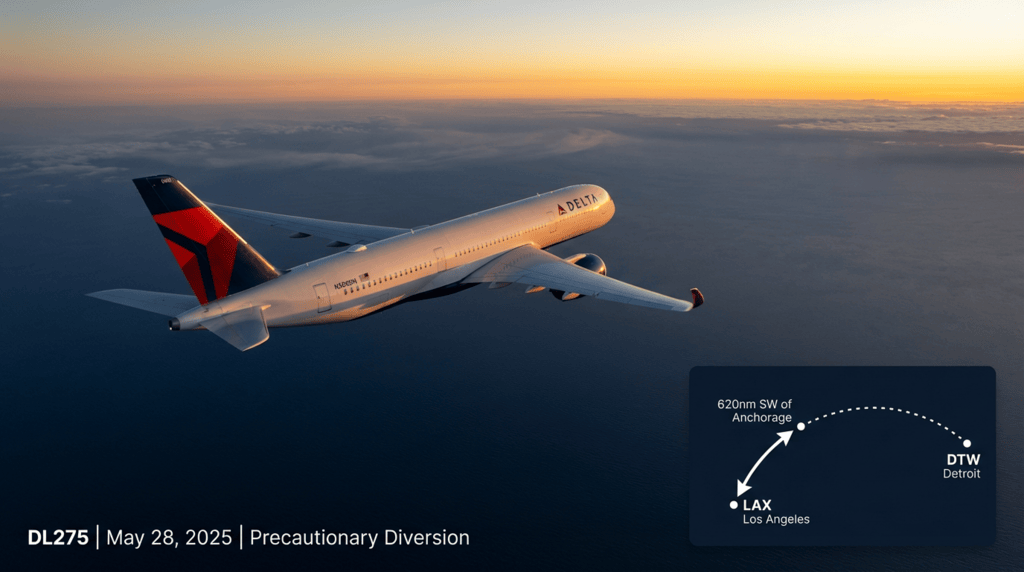
On May 28, 2025, Delta Air Lines Flight DL275 did something most transpacific flights never do: it turned around over the Pacific Ocean and landed in Los Angeles instead of Tokyo. Passengers who had settled in for a 13-hour journey from Detroit found themselves disembarking at LAX in the early morning hours, 12 hours and 15 minutes after departure and more than 6,000 miles from where they expected to be.
What actually happened aboard that Airbus A350-900 over the North Pacific, and what does it reveal about how modern long-haul aviation handles the moment when a system warning appears over one of the world’s most remote flight corridors?
Delta Flight DL275 diverted LAX defined: On May 27-28, 2025, Delta Air Lines Flight DL275, an Airbus A350-900 registered N508DN, diverted from its scheduled Detroit Metropolitan Wayne County Airport (DTW) to Tokyo Haneda Airport (HND) route to Los Angeles International Airport (LAX) following a cockpit warning indicating a malfunction in the Rolls-Royce Trent XWB engine anti-ice system. The aircraft was approximately 620 nautical miles southwest of Anchorage, Alaska when the crew initiated the diversion. The flight landed safely on Runway 06R at 1:38 AM on May 28. No injuries were reported. No NTSB accident investigation was opened, confirming the event was classified as a precautionary diversion rather than an emergency.
Here is the complete timeline, the technical cause, and why the crew made the decisions they did at each step.
The Exact Timeline of the DL275 Diversion
Departure: May 27, 2025, approximately 1:15 PM, Detroit (DTW)
DL275 pushed back from Detroit Metropolitan Wayne County Airport as a routine international service. The Airbus A350-900 is Delta’s standard aircraft for this route, chosen specifically for its range, fuel efficiency, and advanced monitoring systems. Standard load for this route is 306 passengers across three cabin classes. The crew followed a standard great-circle routing northwest from Detroit, crossing Canadian airspace before arcing toward Alaska and beginning the Pacific crossing.
Hours 1-5: Normal cruising, 38,000 feet
For the first five to six hours, everything operated within normal parameters. The aircraft climbed to its cruising altitude of 38,000 feet and followed its planned oceanic track. Pacific routes do not have radar coverage once aircraft move beyond the North American coast, so crews rely on ADS-B position reporting and ACARS data link communications to stay in contact with airline operations centers on the ground.
Hour 6: Anti-ice system warning detected
Approximately six hours into the flight, cockpit monitoring systems generated an alert from the engine anti-ice system on one of the two Rolls-Royce Trent XWB engines. Sensor data showed three concurrent anomalies: reduced anti-ice flow, rising vibration levels, and slight temperature deviations outside the expected operational range. The engines themselves continued functioning normally. The alert did not indicate engine failure. It indicated that a protective system responsible for preventing ice buildup on engine components was not delivering the required safety margin.
The diversion decision: 620 nautical miles southwest of Anchorage
At the point the warning was assessed, DL275 was approximately 620 nautical miles southwest of Anchorage, Alaska. This position sits near the critical inflection point on Pacific routes where continuing west and landing in Asia becomes roughly equivalent in distance to turning back toward North America. The crew did not continue to that inflection point. They initiated the diversion immediately after reviewing the alert and consulting with Delta’s operations control center on the ground.
The choice of Los Angeles over Honolulu or Anchorage reflects ETOPS operational planning. ETOPS, Extended-range Twin-engine Operational Performance Standards, requires airlines to designate specific diversion airports for transoceanic routes before each flight. Delta designated LAX as a primary diversion point for DL275 because it offers maintenance facilities certified for the Airbus A350 and Rolls-Royce Trent XWB engines, Delta hub infrastructure with full passenger rebooking capability, runway length suitable for a heavy A350 with partial fuel load, and customs and immigration facilities for an international flight with passengers who had not yet cleared Japan.
Honolulu would have required continuing west. Anchorage’s runway and maintenance infrastructure for wide-body aircraft is more limited than LAX. Los Angeles was the right call.
Landing: 1:38 AM, Runway 06R, LAX, May 28, 2025
The aircraft landed on Runway 06R at Los Angeles International Airport after 12 hours and 15 minutes in the air. During the final approach, the crew performed normal landing checklists. No fire suppression was activated. No emergency vehicles were requested at the gate. The aircraft taxied under its own power to the gate. Delta confirmed the diversion was precautionary in a statement issued within hours of landing.
What Failed: The Rolls-Royce Trent XWB Anti-Ice System Explained
Understanding the specific system that generated the warning is useful because it explains why a pilot cannot simply note the alert and continue flying.
The Rolls-Royce Trent XWB is the only engine designed for the Airbus A350. It is a three-shaft turbofan producing approximately 75,000 to 97,000 pounds of thrust depending on the variant. The XWB designation stands for extra-wide body, reflecting the engine’s design specifications for the A350 airframe.
At 38,000 feet, outside air temperature falls between -56°C and -65°C (-69°F to -85°F) on a standard day. Moisture present in the atmosphere at that temperature can freeze on contact with metal surfaces inside the engine. Ice forming on fan blades, inlet guide vanes, or compressor stages disrupts airflow in ways that reduce engine efficiency and, in severe cases, can cause damage or flameout.
The engine anti-ice system counters this by routing hot bleed air from the compressor section through ducts in the engine inlet and nacelle, keeping critical surfaces warm enough to prevent ice formation. When the system detects reduced flow, temperature deviation, or abnormal vibration simultaneously, it cannot confirm the protective function is operating correctly.
Here is why that matters specifically on a Pacific crossing: the route from the diversion point to Tokyo passes through increasingly cold and moisture-rich air as the aircraft tracks northwest toward Japan. A system that is already showing marginal performance at 620 nautical miles from Anchorage will face more demanding conditions, not fewer, in the hours ahead. The decision calculus is not “is the engine working now?” It is “will the system maintain adequate protection for the remaining eight to nine hours over water?”
The crew answered that question correctly and turned around.
According to the International Air Transport Association’s 2024 Safety Report, engine-related system alerts on modern widebody aircraft result in precautionary diversions at a rate of approximately 0.4 per 100,000 flight hours across the global commercial fleet. The vast majority are classified as precautionary, with no subsequent confirmation of imminent failure. That statistical pattern is consistent with what happened on DL275.
Why No NTSB Investigation Was Opened
A question many readers ask after following this story online is whether the National Transportation Safety Board investigated the DL275 diversion. The answer is no, and understanding why matters for accurately framing the severity of the event.
The NTSB opens investigations into aviation accidents and incidents. Under 49 CFR Part 830, a reportable incident includes events such as flight crew incapacitation, engine failure with sustained damage, structural failure, or fire requiring suppression. A precautionary diversion triggered by a sensor anomaly, where the aircraft lands safely with no damage, no injuries, and no confirmation of actual system failure, does not meet the threshold for a mandatory NTSB investigation.
Delta submitted standard ASAP (Aviation Safety Action Program) documentation, as required for any in-flight system alert. The aircraft, N508DN, was inspected by certified maintenance technicians at LAX. Following inspection and required maintenance sign-off, the aircraft returned to the Detroit-Tokyo Haneda service without further reported anomalies.
As of early 2026, FlightAware tracking data confirms DL275 continues operating the Detroit to Tokyo Haneda route on its normal schedule.
What Happened to the Passengers
For the 306 passengers aboard DL275, the diversion meant a significant disruption to travel plans. Delta’s standard diversion protocol activated immediately upon landing.
Passengers were deplaned normally at an international gate. Because the flight had not cleared Japanese customs, passengers retained their international status and were processed through U.S. customs at LAX as a technical stop rather than a standard entry. Delta provided hotel accommodations for passengers who required overnight stays, meal vouchers, and rebooking on the next available Detroit-Tokyo or connecting services through Delta’s partner network including Japan Airlines.
Under DOT regulations governing passengers on international flights operated by U.S. carriers, mechanical diversions qualify as carrier-initiated disruptions. Passengers whose travel was materially impacted were entitled to full refunds if they chose not to rebook, in addition to the immediate hotel and meal support provided.
No passenger injuries were reported. No medical emergencies occurred during the flight. The cabin crew managed the situation with standard diversionary communication protocols, informing passengers of the routing change without specifying technical details that would not be relevant to their immediate needs.
What DL275 Reveals About Pacific Route Safety
The DL275 incident is worth examining beyond its immediate facts because it illustrates how ETOPS regulations, aircraft monitoring technology, and crew training interact in exactly the way they were designed to.
Pacific routes represent some of the most demanding operational conditions in commercial aviation. Limited diversion airports, extreme cold at altitude, and long overwater segments mean that the margin for error on system failures is lower than on continental routes. ETOPS rules specifically address this by requiring airlines to demonstrate that their aircraft, crew, and operational infrastructure can manage an engine-out scenario with a diversion to a certified alternate airport within a regulated time window.
Delta’s A350-900 fleet carries ETOPS-330 certification, meaning the aircraft is approved for transoceanic operations where the diversion airport is no more than 330 minutes away on a single engine. That certification requires documented maintenance standards, crew training records, and airport infrastructure agreements that were all activated on the night of May 27-28, 2025 when DL275’s anti-ice warning appeared.
The system worked precisely as intended. Not because a failure was averted, but because the warning system detected an anomaly early, the crew followed conservative diversion criteria, and the airline infrastructure at LAX absorbed a 306-passenger international diversion without a single reported safety or welfare failure.
“Airline safety advances quietly, in small decisions and incremental corrections rather than dramatic revelations.” — William Langewiesche, aviation historian and journalist, 2014.
That is the accurate frame for DL275. Not a crisis. A system doing its job.
Frequently Asked Questions About Delta Flight DL275 Diverted LAX
What caused Delta Flight DL275 to divert to LAX?
A malfunction in the Rolls-Royce Trent XWB engine anti-ice system on one engine triggered cockpit alerts showing reduced anti-ice flow, rising vibration, and temperature deviations. The aircraft was approximately 620 nautical miles southwest of Anchorage when the crew initiated the diversion. The diversion was precautionary. Both engines continued operating normally throughout.
When did Delta Flight DL275 divert to LAX?
DL275 departed Detroit on May 27, 2025 and landed at LAX at 1:38 AM on May 28, 2025, after 12 hours and 15 minutes airborne. The anti-ice system warning was detected approximately six hours into the flight.
What aircraft was used on Delta Flight DL275?
An Airbus A350-900 registered N508DN, powered by Rolls-Royce Trent XWB engines. The A350-900 is the standard aircraft for Delta’s Detroit to Tokyo Haneda route.
Were any passengers injured on Delta Flight DL275?
No. Zero injuries were reported. The diversion was precautionary and the aircraft remained stable throughout the flight. All 306 passengers were safely deplaned at LAX and Delta provided hotel, meals, and rebooking support.
Did the NTSB investigate the DL275 diversion?
No. The NTSB did not open a formal investigation because the event was a precautionary diversion with no confirmed damage, no injuries, and no system failure meeting the threshold for a mandatory reportable incident under 49 CFR Part 830. Delta filed standard ASAP program documentation.
Why did DL275 divert to LAX instead of Honolulu or Anchorage?
LAX is a Delta hub with Airbus A350 maintenance certification, Rolls-Royce Trent XWB-qualified technicians, and full passenger rebooking infrastructure. Honolulu would have required continuing west toward Japan. Anchorage’s wide-body maintenance capabilities are more limited. Under Delta’s ETOPS-330 operational planning for this route, LAX was the pre-designated primary diversion airport.
Is Delta Flight DL275 still operating?
Yes. As of early 2026, FlightAware tracking data confirms DL275 continues operating the Detroit Metropolitan Airport to Tokyo Haneda route on its regular schedule without further reported diversions.
Key Takeaways
Delta Flight DL275 diverted to LAX on May 28, 2025 because a Rolls-Royce Trent XWB engine anti-ice system generated sensor anomalies over the North Pacific that the crew could not verify would hold through eight more hours of cold oceanic flight. They turned the aircraft around 620 nautical miles from Anchorage, flew 12 hours and 15 minutes total, and landed on Runway 06R at LAX at 1:38 AM. No one was hurt. No investigation was opened. The aircraft returned to service.
The story is not about what went wrong. It is about what went right. A monitoring system caught an anomaly early. A crew followed conservative criteria. An airline delivered 306 passengers safely to an alternate airport with hotel, meals, and rebooking. Every layer of the aviation safety system performed exactly as designed.
Three things worth knowing before your next transpacific flight:
- Diversions are not failures. A flight that diverts because of a system warning is safer than one that continues past a point where diversion becomes impossible. The DL275 crew made the correct call at the correct moment.
- ETOPS certification matters. The reason LAX was ready to handle DL275 at 1:38 AM with maintenance teams, customs support, and rebooking infrastructure is that transoceanic routes require airlines to pre-plan exactly this scenario. It is not improvised.
- Track your flights in real time. FlightAware and Flightradar24 both provide live tracking and historical playback for specific flight numbers. If you are on a transpacific route and notice an unusual course change, these tools give you accurate position data rather than speculation.
Billionscope covers aviation safety, airline incident reporting, and travel intelligence for U.S. readers who need accurate information rather than sensationalized event recaps.