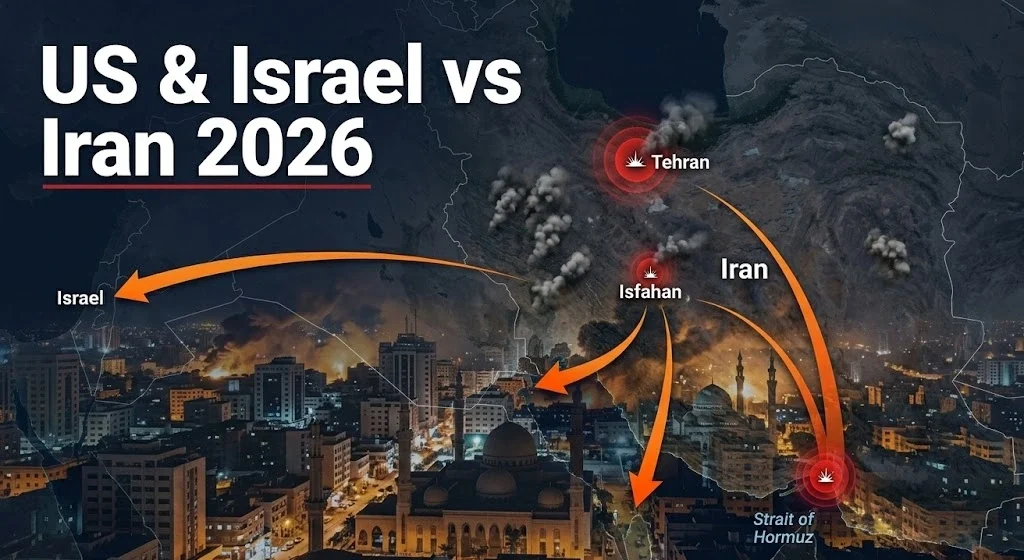
Picture this: you wake up Saturday morning, check your phone, and see that the United States is officially at war with Iran. Not a skirmish. Not airstrikes on a proxy. A full-scale joint military operation with Israel — targeting Tehran itself. That’s exactly what happened on February 28, 2026. And if you’re still trying to make sense of it, you’re not alone. Here’s a clear, no-spin breakdown of the US-Israel attack on Iran — why it happened, what’s unfolding right now, and how it could hit your wallet.
Why Did the US and Israel Attack Iran?
The road to this war didn’t start last week. Tensions between Iran and the US and Israel escalated sharply following the October 7 attacks in 2023, which kicked off the Gaza war and led to Israel progressively weakening Iranian-backed groups across the Middle East — including Hamas in Gaza and Hezbollah in Lebanon. Al Jazeera
By early 2026, things were at a boiling point. In January 2026, Iranian security forces killed thousands of protesters during the largest unrest since the Islamic Revolution. Trump responded by announcing “help is on the way.” Al Jazeera Quiet diplomatic talks through Oman followed — but they collapsed fast.
US Special Envoy Steve Witkoff described the final unsuccessful efforts to reach a nuclear agreement with Iran as falling apart just days before the US launched major combat operations. House of Commons Library Trump had issued a hard deadline. When Iran didn’t budge, the bombs started falling.
Trump stated that the US-led operation aimed to eliminate Iran’s nuclear and missile programs, destroy the country’s navy, and change its leadership — addressing the Iranian public directly in an early morning video saying the country “will be yours to take.” Columbia University
What Happened in the First 72 Hours
The opening strikes were massive. On February 28, 2026, a US armada of two aircraft carrier strike groups and scores of advanced aircraft, together with the Israeli Air Force, launched a sustained military attack on Tehran and other Iranian cities, destroying military and official targets and killing Supreme Leader Ayatollah Ali Khamenei. Al Jazeera
Iran’s retaliation was immediate and widespread. Kuwait intercepted 178 ballistic missiles and 384 drones. The UAE intercepted 169 out of 182 detected missiles, with the rest landing in the sea, plus 645 drones. Bahrain intercepted 70 missiles and 76 drones. Wikipedia
It wasn’t just military targets getting hit. Iran’s strikes reached urban centers, energy infrastructure, airports, and hotels — shaking populations in Gulf countries long accustomed to relative security. Wikipedia Dubai’s Fairmont The Palm hotel was struck. RAF Akrotiri in Cyprus was hit by a suspected drone. The US Embassy in Riyadh was targeted.
By day four, six US service members had been killed and 18 injured. Trump vowed the US would retaliate “soon,” while ruling out boots on the ground — for now. Al Jazeera
The Strait of Hormuz: Why This War Hits Your Gas Tank
Here’s where this conflict stops being a foreign policy story and becomes a personal finance story.
About a third of seaborne oil exports and 20% of global liquified natural gas exports pass through the Strait of Hormuz. A prolonged closure of the strait could tip the global economy into a recession. NPR
Iran threatened exactly that. The conflicts triggered a de facto closure of the Strait of Hormuz, which handles 20% of global petroleum consumption. Oxford Economics
The numbers from analysts are alarming. Every $10 increase in oil prices raises US consumer inflation by 0.5%. If crude hits $130 per barrel, inflation could jump to 5.5% — forcing the Federal Reserve to hike interest rates. Gasoline prices, already around $4 per gallon, could surge to $7 or more. Clear View Energy Partners estimates such a spike could add up to $2,500 annually to household fuel expenses. CNN
Experts estimate that $100 per barrel of oil translates to roughly $4 per gallon at the pump. To counter a price surge, the US government may authorize releases from the Strategic Petroleum Reserve — which held approximately 415 million barrels as of February 20, 2026. Oxford Economics That’s a buffer, but it’s not unlimited.
Can Regime Change Actually Happen in Iran?
This is the big question — and experts aren’t optimistic about a quick answer.
The Iranian regime survived major economic devastation from US sanctions, four rounds of mass protests since 2009, and a massive internal uprising in January 2026 — mainly through brutal state violence. Iran’s government is a hard target. Despite its unpopularity, the Islamic Republic will not collapse easily. Al Jazeera
The initial airstrike that killed Khamenei and several family members inflicted a heavy blow on the regime — but it neither toppled it nor produced an immediate wave of popular opposition. The regime’s radical core appears to be entrenching itself rather than seeking accommodation with the Trump administration. CNBC
It appears likely that it would take more than the initial phase of several weeks to bring about regime change. CNBC
As the CFR’s Max Boot put it: “It’s easy to start a war. It’s very hard to end one successfully.” He drew direct parallels to Bush’s experience in Iraq and Afghanistan. Columbia University
Even on the home front, the war faces political headwinds. Polling in February 2026 showed only 21% of Americans supported strikes on Iran, while 49% saw them as unnecessary and expensive. Al Jazeera
What Investors and Markets Are Watching Right Now
If you have a 401(k), a mortgage, or even just a job — this conflict affects you beyond the gas station.
Oil, gas, out-of-region energy stocks, gold, and aerospace and defense stocks are all expected to spike. Oxford Economics analysts advise selling extreme moves in these sectors, as they’ll fade when the conflict — which they project won’t last beyond two months — ends. FinancialContent
Defense companies are already seeing strong demand, and that trend is expected to continue. Meanwhile, tourism, leisure, and consumer sectors may face declining demand as households pull back on discretionary spending. Al Jazeera
In a worst-case scenario — a combination of Strait of Hormuz closure and sustained regional conflict — crude prices could surge past $100 per barrel. Prolonged conflict and a full closure would likely result in a global recession. Oxford Economics
Three Things to Watch in the Days Ahead
The situation is evolving by the hour. These are the signals that will determine how this plays out:
- Hezbollah’s next move — Whether Hezbollah heeds Iran’s call to escalate, including against US targets and inside Israel, is the critical variable to watch. Columbia University
- Iran’s new leadership — Ali Larijani announced an Interim Leadership Council on March 1 and warned against any secessionist groups. Who consolidates power in Tehran shapes everything. Al Jazeera
- Ceasefire signals — Oman’s foreign minister urged a ceasefire on a call with Iran’s foreign minister, who said Tehran is open to “any serious efforts at de-escalation.” Any diplomatic breakthrough will immediately move oil markets. House of Commons Library
The US-Israel attack on Iran is the most consequential military action in the Middle East since the 2003 Iraq invasion. Whether it achieves its stated goals — or spirals into something far larger — depends on the next few weeks. Keep watching. Keep asking questions. And understand that what happens in the Strait of Hormuz doesn’t stay in the Strait of Hormuz.