
Sodiceram is generating real interest across architecture, construction, and industrial manufacturing communities. And most of the content written about it is either vague marketing copy lifted from product pages or so technically sparse it leaves you with no useful information at all.
Here is what you actually need: a clear definition grounded in material science, the specific performance numbers that separate sodiceram from conventional ceramics, an honest look at where the evidence is solid and where independent verification is still thin, and a practical checklist for anyone specifying or purchasing this material for a real project.
That is exactly what this guide delivers.
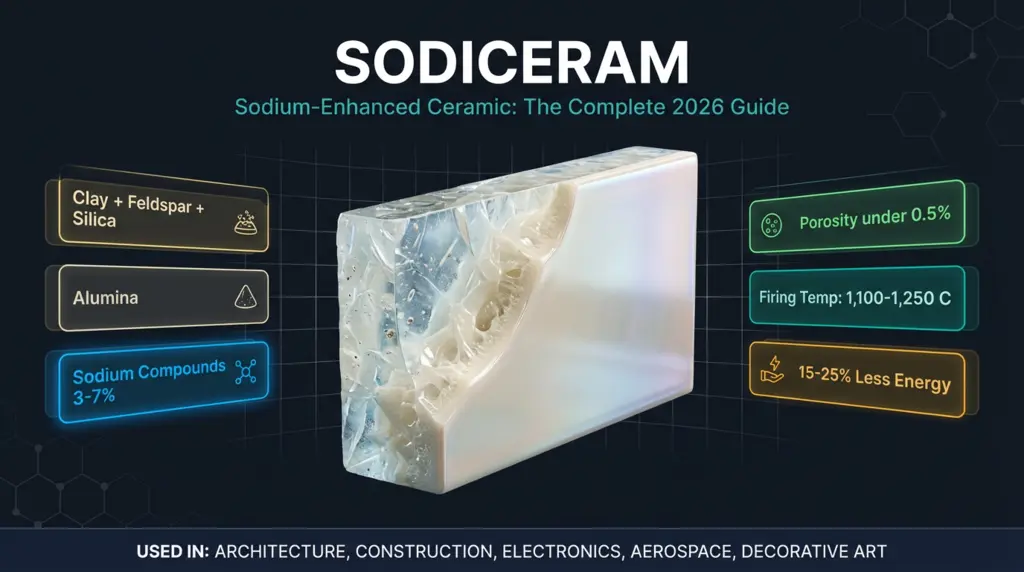
Sodiceram defined: Sodiceram is an advanced ceramic material engineered by integrating sodium-based compounds into the traditional ceramic matrix of clay, feldspar, silica, and alumina. The sodium compounds, typically sodium oxide, sodium silicates, or sodium feldspar derivatives at concentrations of 3 to 7 percent by weight, act as fluxing agents during the firing process. They lower the temperature at which vitrification occurs, produce a denser internal microstructure, and reduce residual porosity to levels that conventional porcelain cannot reach without significantly higher kiln temperatures.
The name combines “sodi” from sodium with “ceram” from ceramics. It is both a material category descriptor and, increasingly, a branding term adopted by manufacturers positioning sodium-enhanced ceramic products in the construction and design markets. That dual use matters when you are researching it, because not everything called sodiceram comes from the same formulation or the same verified performance standard.
Before you specify or purchase, here is what you need to know.
The Science Behind Sodiceram: What Sodium Actually Does to Ceramic
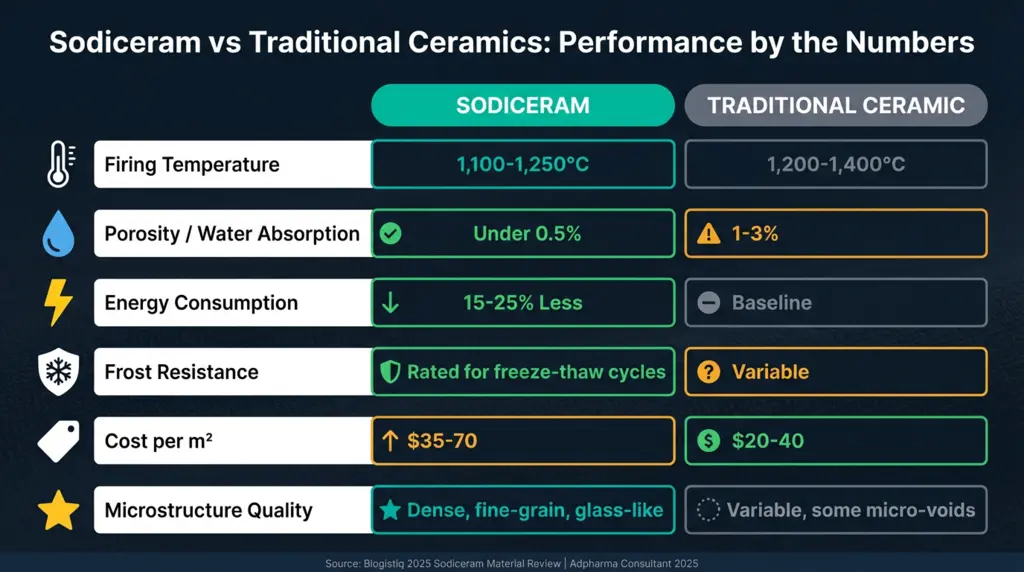
Traditional ceramics are fired at temperatures between 1,200 and 1,400 degrees Celsius, depending on the clay body and application. At those temperatures, silica and alumina particles bond through sintering, forming a rigid structure. The challenge is that without sufficient temperature or duration, incomplete sintering leaves micro-voids inside the material. Those voids become pathways for moisture, stress concentrations under load, and sites for bacterial or chemical infiltration in sensitive applications.
Sodium compounds change that process at the molecular level.
When sodium oxide, sodium silicate, or sodium feldspar derivatives are introduced into the ceramic mix, they act as fluxes during firing. A flux lowers the activation energy required for particle bonding, which means vitrification begins at a lower temperature and proceeds more completely within the same or shorter kiln time. The practical result is a denser ceramic with fewer internal voids.
The specific improvements that sodium integration produces:
Fine-grain microstructure develops because sodium accelerates and completes the bonding process between smaller particles that would otherwise fuse incompletely at lower temperatures. The grain boundaries become tighter, improving mechanical performance under both compressive and flexural loading.
Porosity drops significantly. Conventional porcelain tiles typically show water absorption rates of 1 to 3 percent, reflecting residual internal porosity. Sodiceram formulations, when properly executed, push that figure below 0.5 percent. That single number has major practical implications: moisture resistance, frost resistance, stain resistance, and suitability for outdoor and high-humidity applications all improve proportionally.
Firing temperature requirements decrease by 150 to 300 degrees Celsius depending on the formulation. According to analysis from Blogistiq’s 2025 sodiceram material review, that reduction translates to energy consumption savings of 15 to 25 percent compared to traditional ceramic firing. For a large-scale manufacturer firing thousands of square meters per month, that saving is operationally significant.
Glaze adhesion improves because the denser, more uniform surface created by sodium-enhanced vitrification provides a more consistent substrate for glaze and finish application. Surface coatings bond more evenly, which matters both aesthetically and functionally for exterior-rated applications.
“Sodiceram’s reduced firing temperature requirements can decrease energy consumption by 15 to 25 percent, translating to significant carbon footprint reductions across the industry.” — Blogistiq Material Science Review, 2025.
Where Sodiceram Is Used: Six Industries Worth Knowing
The performance characteristics of sodiceram make it a practical fit across a wider range of industries than conventional ceramics reach. Here are the six sectors where adoption is most active and the specific reasons sodiceram outperforms alternatives in each.
Architecture and Construction — Tiles, large-format slabs, facade cladding, and flooring represent the largest current application category. The combination of low porosity, frost resistance, and high-impact strength makes sodiceram tiles suitable for both interior and exterior specification in climates with significant temperature variation. The material qualifies for LEED certification consideration due to reduced production energy requirements. Cost per square meter runs $35 to $70, sitting between standard porcelain ($20 to $40) and natural stone ($60 to $120) while outperforming both on durability metrics per dollar of total lifecycle cost.
Industrial Equipment and Components — Extreme-temperature environments in chemical plants, industrial furnaces, and processing facilities need materials that resist both thermal stress and chemical corrosion simultaneously. Sodiceram’s dense microstructure resists acids, alkalis, and corrosive gases better than conventional ceramics whose residual porosity creates sites for chemical penetration over time.
Electronics and Semiconductors — Sodium-enhanced ceramics demonstrate excellent electrical resistance while maintaining thermal stability. Insulators and substrates in electronic devices benefit from the material’s combination of heat resistance and dimensional stability under operating conditions. This application space is earlier-stage than construction but growing rapidly according to AMF-CO’s 2025 industry analysis.
Aerospace Components — Heat shields, thermal insulation panels, and structural elements exposed to high-velocity thermal cycling represent a demanding application category where sodiceram’s fine-grain microstructure proves its value. The material maintains structural integrity across rapid temperature transitions that cause conventional ceramics to microcrack over repeated cycles.
Healthcare and Medical Equipment — Biocompatibility is a critical requirement for materials used in dental applications and medical device components. Sodiceram’s controlled chemical composition and dense, non-porous surface support biocompatibility certifications while offering the mechanical durability clinical environments require.
Decorative Art and Design — Artists and designers working with sodium-enhanced ceramics gain access to glaze and surface finish effects that conventional ceramics cannot achieve. The more uniform substrate enables richer color development, sharper digital print registration on tiles, and more predictable glaze behavior in custom production runs.
The Honest Assessment: What Sodiceram Claims Need Independent Verification
This is where most articles on sodiceram fail their readers entirely. Promotional content and material science content have started to blend in ways that make it genuinely difficult to separate manufacturer claims from independently verified performance data.
Here is a clear-eyed look at what is substantiated and what still needs verification before you stake a project on it.
Well-substantiated: The underlying chemistry of sodium as a ceramic flux is decades-old, peer-reviewed materials science. Sodium oxide, sodium silicates, and sodium feldspar have been used in ceramic glazes and bodies for over a century. The basic mechanisms described above are not marketing claims — they are standard ceramic chemistry. Any formulation that genuinely integrates 3 to 7 percent sodium compounds as described will produce some version of the benefits outlined here.
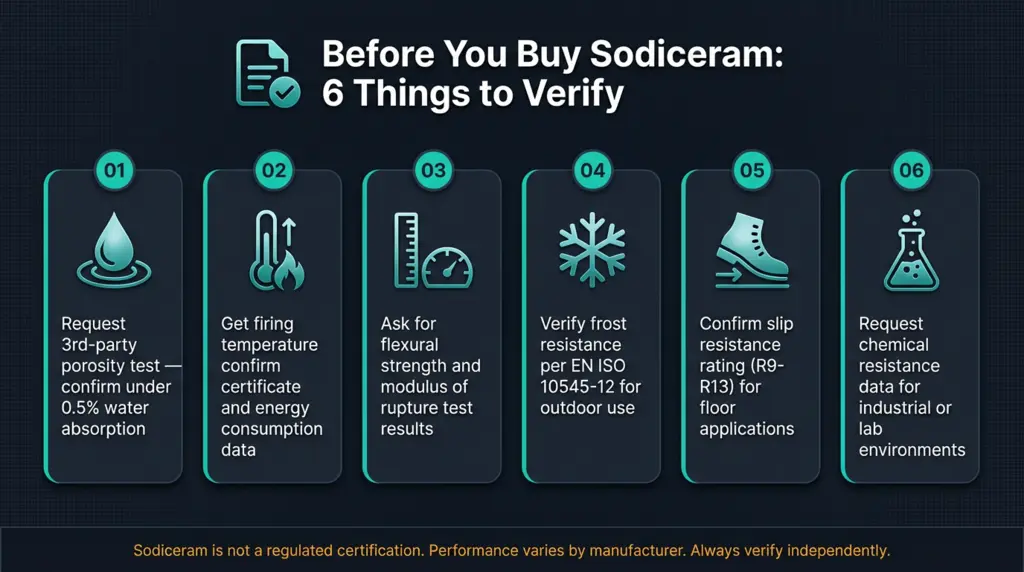
Requiring case-by-case verification: Specific performance numbers vary significantly between manufacturers and formulations. A sodiceram product claiming “under 0.5% porosity” should be able to provide a third-party laboratory test report confirming that figure for that specific product. Flexural strength ratings, frost resistance classifications (EN ISO 10545-12 for freeze-thaw testing), slip resistance ratings (R9-R13 classifications for floor applications), and chemical resistance data should all come from independent testing, not from marketing materials.
Important context: The term “sodiceram” is not currently a registered certification standard or a formally regulated material category. Any manufacturer can use the term. That means the quality, performance, and sodium content of products marketed as sodiceram varies widely. Welfulloutdoors’ 2025 buyer guide makes this point clearly: treat sodiceram as a category descriptor, not a quality guarantee, and demand technical datasheets for any specified product.
“Independent technical validation of sodiceram performance claims is currently limited in public literature. Treat marketing claims as directional and request manufacturer test reports before specifying.” — Welfulloutdoors Sodiceram Buyer Guide, 2025.
Sodiceram vs Competing Advanced Materials
Understanding where sodiceram sits relative to competing advanced materials helps you make a rational specification decision rather than a marketing-driven one.
| Material | Avg Cost per m2 | Porosity | Key Strength | Key Limitation |
| Sodiceram | $35-$70 | Under 0.5% | Durability, eco-profile, design versatility | No single regulatory standard yet |
| Standard Porcelain | $20-$40 | 1-3% | Established, widely available | Higher porosity, higher firing energy |
| Natural Stone | $60-$120 | Variable | Aesthetic premium | High maintenance, inconsistent quality |
| Sintered Stone | $55-$90 | Under 0.1% | Ultra-low porosity | Higher cost, limited supplier base |
| Nanoceramics | $80-$150 | Under 0.3% | Extreme performance | Premium pricing limits applications |
Bottom line: Sodiceram sits in a competitive sweet spot for projects that need performance beyond standard porcelain but cannot justify sintered stone or nanoceramic pricing. Its strongest comparative advantage is the combination of low porosity, lower production energy, and design versatility at a mid-range price point.
Frequently Asked Questions About Sodiceram
What is sodiceram made of?
Sodiceram is made from the same base materials as traditional ceramics: clay, feldspar, silica (quartz), and alumina. The differentiating ingredient is the addition of sodium-based compounds, typically sodium oxide, sodium silicates, or sodium feldspar derivatives at 3 to 7 percent of the total formulation by weight. These sodium compounds act as fluxes during kiln firing, enabling deeper vitrification at lower temperatures.
Is sodiceram better than porcelain?
For most demanding applications, yes. Sodiceram achieves porosity below 0.5 percent compared to the 1 to 3 percent typical of standard porcelain. It fires at 150 to 300 degrees Celsius lower temperatures, reducing energy consumption by 15 to 25 percent. It offers better frost resistance, stain resistance, and moisture resistance. The trade-off is cost: sodiceram typically runs $35 to $70 per square meter versus $20 to $40 for standard porcelain.
Is sodiceram safe for food contact and healthcare environments?
Sodiceram’s dense, non-porous surface and controlled chemical composition generally support food-safety and healthcare biocompatibility applications. However, formal FDA food-contact certification or ISO 13485 medical device compliance depends on the specific manufacturer’s formulation and testing. Request the relevant certification documentation from your supplier for any food or medical application.
How does sodiceram perform outdoors?
The combination of low porosity, strong frost resistance, and UV color stability makes sodiceram well-suited for exterior architectural applications. Products verified to EN ISO 10545-12 freeze-thaw standards are rated for outdoor use in climates with significant temperature cycling. Always confirm the specific outdoor rating of the product you are specifying.
Can sodiceram be used in 3D printing?
Researchers are actively developing sodiceram formulations compatible with ceramic 3D printing technologies. Current production is primarily through traditional press-and-fire methods. Commercial 3D-printable sodiceram products are not yet widely available as of early 2026, but the material science pathway is established and production versions are expected within 2 to 3 years.
Where can I buy sodiceram products in the USA?
Sodiceram is available through specialty tile and architectural materials suppliers, European ceramic importers, and direct from manufacturers positioned in the mid-to-premium ceramic market. Because sodiceram is an emerging category term without a single dominant brand behind it in the U.S. market, the most reliable sourcing path is working directly with a materials supplier who can provide verified technical datasheets for the specific product they are stocking.
Key Takeaways
Sodiceram is a genuinely meaningful advancement in ceramic material science, not marketing hype invented from thin air. The underlying chemistry is real, decades-tested, and well-understood. Sodium compounds as ceramic fluxes lower firing temperatures, increase microstructural density, reduce porosity, and improve mechanical performance in ways that conventional ceramics at the same price point cannot match.
The honest caveat is equally important: sodiceram is not yet a regulated certification standard. Any manufacturer can use the term. Product quality varies significantly between suppliers. The specification checklist above is your practical defense against the gap between category marketing and actual product performance.
Your next steps, in order:
- Right now (5 minutes): If you are evaluating sodiceram for a specific project, identify the performance requirement that matters most to your application: porosity for moisture environments, frost resistance for exteriors, flexural strength for heavy-traffic flooring, or chemical resistance for industrial use. That single priority should anchor every conversation with a supplier.
- Before specifying (30 minutes): Use the six-point checklist from the section above to request documentation from any sodiceram supplier. A supplier who cannot provide third-party test data for their product is telling you something important about the product.
- This month: For large-scale architectural or industrial procurement, consider requesting a small sample batch for independent laboratory testing before committing to a full specification. The cost of lab testing is trivially small relative to the cost of a wrongly specified material at scale.
Billionscope covers emerging materials, technology, and industry trends for readers who need accurate, evidence-grounded information before making real decisions. The related guides below go deeper on advanced ceramic alternatives and sustainable building materials.
