
You’ve spent real money on good fabric. You’ve cut everything carefully. You’ve pressed your pattern pieces. And then you’ve sewn a French seam on denim — and spent the next hour fighting a seam that’s three times too bulky to press flat.
Or you’ve sewn a plain seam on chiffon and watched the raw edges fray on the first wash.
Wrong seam choice doesn’t just look bad. It structurally weakens your garment, wastes fabric, and costs you time you can’t get back. And yet most guides on nahttypen list seam names with a sentence or two of description and no practical guidance on when — and equally important, when not — to use them.
Here’s the thing most sewing guides skip entirely: nahttypen aren’t just technique variations. They’re engineering decisions. Each one is optimized for a specific combination of fabric weight, stretch, end use, and finishing requirement. Choose correctly and your garment outlasts trends. Choose wrong and you’re repairing seams after the third wear.
Nahttypen defined: Nahttypen (German plural of Nahttyp) means “seam types” — the different construction methods used to join fabric pieces together by stitching, folding, or bonding. Each nahttyp determines how raw edges are handled, how seam allowances are positioned, and how many stitch lines are used. The right nahttypen choice affects a garment’s durability, comfort, stretch, and finished appearance.
Studies from textile engineering research show that garments sewn with correctly matched nahttypen last up to 30% longer under daily wear than those sewn with mismatched seam types, according to research published in the Journal of Textile and Apparel Technology and Management (2025).
Start here: which category fits your project right now?
Quick Answers: The Most Common Nahttypen Questions
Q: What does nahttypen mean in English? A: Nahttypen is German for “types of seams” — the different methods used to join fabric in sewing and garment construction. It directly translates to “seam types” and is used in both home sewing and professional garment manufacturing contexts.
Q: Which nahttyp is strongest? A: The flat-felled seam (Kappnaht) is consistently rated as the strongest seam type for garments, used in jeans, workwear, and military uniforms precisely for its double-stitched, enclosed construction.
Q: Which nahttyp is best for beginners? A: The plain seam (Einfachnaht) is the correct starting point. It teaches seam allowance control, pressing technique, and machine settings before adding the complexity of multi-step seams.
What Nahttypen Are — And Why Most Sewers Choose Wrong
Before the seam types themselves, one distinction matters enormously that almost no guide clarifies.
Seam types and stitch types are not the same thing. Stitch types are the patterns your machine creates — straight stitch, zigzag stitch, stretch stitch. Nahttypen are the construction methods that use those stitches to connect fabric. A French seam uses a straight stitch — but it’s an entirely different nahttyp because the fabric is folded and stitched twice to enclose raw edges completely.
Understanding this distinction is what separates intentional sewing from guesswork. Once you know the nahttypen method, you know exactly which stitch setting, seam allowance, and pressing technique goes with it. That’s the level every project needs to reach — and that’s what this guide delivers.
But here’s where it gets interesting: most sewing errors don’t come from not knowing seam names. They come from choosing based on habit rather than fabric behavior. Your default seam — whatever you sew most — is probably right for about 40% of your projects and wrong for the rest.
The 8 Essential Nahttypen Every Sewist Must Know
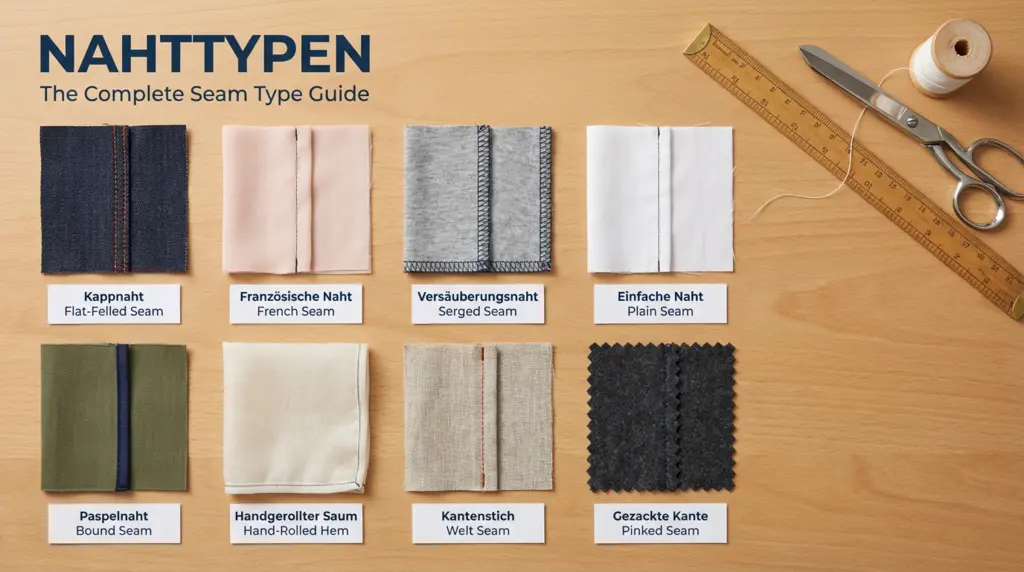
Here’s the full comparison table before the detailed breakdowns — a reference you can bookmark and return to every time you start a new project.
| Nahttyp (German) | English Name | Best Fabric | Strength | Skill Level |
| Einfachnaht | Plain Seam | Cotton, linen, wovens | Medium | Beginner |
| Französische Naht | French Seam | Chiffon, silk, organza | Medium-High | Intermediate |
| Kappnaht | Flat-Felled Seam | Denim, canvas, shirting | Very High | Intermediate |
| Overlocknaht | Overlock Seam | Knit, jersey, stretch | High | Beginner–Inter |
| Zickzacknaht | Zigzag Seam | Stretch, knitwear | Medium | Beginner |
| Lappnaht | Lapped Seam | Leather, canvas, coats | High | Intermediate |
| Saum | Hem Seam | All fabrics (edge finish) | Low–Medium | Beginner |
| Dekorative Naht | Decorative/Topstitch Seam | Denim, cotton, structured | Varies | Intermediate |
Now for the depth each one actually deserves.
1. Einfachnaht — The Plain Seam
The plain seam is the foundation of all nahttypen. Two fabric pieces are placed right sides together, stitched along the seam allowance (typically 1–1.5 cm for garments), and pressed open or to one side.
Use it for: Woven cotton, linen, medium-weight fabrics, garment linings, basic construction on blouses, dresses, and structured clothing.
Don’t use it for: Sheer fabrics where raw edges show through. Stretch fabrics where it will snap under tension. Anything worn frequently in high-stress areas like crotch seams or shoulder seams without a second line of reinforcement.
Machine setting: Straight stitch, 2.0–2.5mm stitch length. Standard presser foot. Seam allowance: 1.5cm.
Pro tip: Always finish raw edges after sewing a plain seam — with pinking shears, zigzag stitch, or serging. An unfinished plain seam frays within three washes on any fabric looser than tightly woven cotton.
2. Französische Naht — The French Seam
The French seam is the most elegant solution for delicate fabrics. It encloses all raw edges completely within a double line of stitching, leaving a perfectly clean interior with no exposed fabric edges — no serging required.
Construction: Sew fabric pieces wrong sides together first, trim seam allowance to 3mm, press, fold so right sides face each other, then sew again at 6mm to encase the first seam inside.
Use it for: Chiffon, organza, silk, fine linen, any lightweight or sheer fabric where fraying is a concern and interior finish matters. Ideal for lingerie, blouses, and bridal wear.
Don’t use it for: Thick or bulky fabrics — the double layer becomes impossible to press flat. Curved seams are difficult unless you clip carefully at the first stitching line. Not suitable for stretch fabrics.
Machine setting: Straight stitch, 1.5–2.0mm stitch length. Slightly reduced presser foot pressure for delicate fabrics.
3. Kappnaht — The Flat-Felled Seam
The flat-felled seam is the strongest nahttyp in everyday garment construction. Both seam allowances are folded and enclosed, with two visible stitch lines on the right side of the fabric. It’s what gives jeans their characteristic double-stitched seams — and their legendary durability.
Construction: Sew a plain seam first. Trim one seam allowance to 6mm. Fold the wider allowance over the trimmed one, press, fold again to encase, and topstitch in place through all layers.
Use it for: Denim, canvas, heavy cotton shirting, workwear, outdoor gear, children’s clothing that takes hard wear. Any project where the interior must be as neat as the exterior.
Don’t use it for: Lightweight or sheer fabrics — the bulk is incompatible. Tight curves are extremely difficult to execute cleanly. Not suitable for knits.
Machine setting: Straight stitch, 2.5–3.0mm stitch length. Walking foot recommended for denim. Denim needle (size 16/100) required for heavy fabric.
4. Overlocknaht — The Overlock Seam
The overlock seam is the professional standard for knit and stretch fabrics. A serger (overlock machine) trims the raw edge and wraps thread around it simultaneously, creating a flexible, fray-proof finish in a single pass.
Use it for: Jersey knit, spandex, activewear, swimwear, t-shirts, and any fabric that needs to stretch with the body without the seam snapping.
Don’t have a serger? A three-step zigzag or stretch stitch on a standard sewing machine approximates the flexibility but won’t match the professional finish. A zigzag at 2.0mm width, 2.5mm length is the closest substitute.
Machine setting (serger): 4-thread overlock. Differential feed set to 0.7–0.9 for lightweight knits, 1.0–1.5 for heavier knits. Needle thread tension adjusted to fabric stretch.
Here’s where most knit sewers go wrong: they use a straight stitch on jersey because it’s the default setting. A straight stitch on stretch fabric snaps at the first pull. Always verify your stitch setting before sewing a single seam on knit fabric.
5. Zickzacknaht — The Zigzag Seam
The zigzag seam is the standard machine alternative to overlocking. It handles stretch and prevents fraying on woven fabrics without requiring a serger. It’s also the go-to for elastic application, appliqué edges, and general raw-edge finishing.
Use it for: Stretch fabrics when a serger isn’t available, raw-edge finishing on woven fabrics, applying elastic or trim, decorative edging.
Machine setting: Zigzag stitch, width 2.0–3.0mm, length 2.0–2.5mm. Reduce presser foot pressure slightly on knits to prevent stretching.
6. Lappnaht — The Lapped Seam
The lapped seam overlaps fabric edges rather than placing them together, then stitches through both layers. This reduces bulk at the seam while maintaining high strength — ideal for materials too thick or stiff to turn back for enclosed seams.
Use it for: Leather, faux leather, thick wool, canvas, structured coats, bags, and any material that doesn’t respond well to pressing or folding.
Don’t use it for: Thin or slippery fabrics where the overlap creates an awkward ridge. Not suitable for garments where the overlapping edge would be visible and aesthetically unwanted.
Machine setting: Straight stitch, 3.0–3.5mm stitch length. Walking foot essential. Leather needle for non-woven materials. Clips instead of pins for genuine leather to avoid permanent holes.
7. Saum — The Hem Seam
The hem seam isn’t a single nahttyp — it’s a category of finishing techniques for the bottom edge of a garment. The three most common:
Blind hem: Nearly invisible from the right side, created with a blind hem stitch or by hand. Best for formal trousers, skirts, and dresses.
Double-fold hem: The raw edge is folded twice and stitched. Most common for casual garments and home textiles. Machine-stitched or hand-stitched depending on the finish required.
Rolled hem: An extremely narrow, delicate finish for lightweight and sheer fabrics. Requires a rolled hem presser foot or meticulous hand rolling. Used on scarves, silk blouses, and formal wear edges.
8. Dekorative Naht — The Decorative/Topstitch Seam
Decorative nahttypen serve both structure and aesthetics. Topstitching flattens seam allowances, adds visible design lines, reinforces stress points, and creates the signature styling detail on denim, sportswear, and tailored garments.
Use it for: Adding visual interest to plain seams on cotton and denim. Reinforcing collar and cuff edges. Creating contrast detailing with contrasting thread color. Securing waistband seams.
Machine setting: Straight stitch, 3.0–3.5mm stitch length (longer than standard for visible impact). Topstitch thread (heavier weight) or double needle for parallel lines. Slightly increased top tension.
How to Choose the Right Nahttyp Every Time
Three questions. Answer them in order before you cut a single seam.
Question 1: What is this fabric? Woven or knit? Light, medium, or heavy weight? Sheer or opaque? Stretch percentage? Your fabric type eliminates most wrong nahttypen choices immediately. Knit fabric cannot use a plain seam without modification. Sheer fabric cannot use a flat-felled seam without showing bulk through the face. Heavy canvas cannot use a French seam without creating an unwieldy interior ridge.
Question 2: Where is this seam on the garment? High-stress areas (shoulder, crotch, armhole, waistband) require stronger nahttypen — flat-felled, double-stitched, or reinforced plain seams. Low-stress areas (side seams on a loose blouse) can use simpler construction. Interior seams that contact skin need smooth, flat finishes — serged or French. Exterior seams on display garments benefit from decorative topstitching.
Question 3: What is the interior finish requirement? If anyone will see the inside of this garment (reversible pieces, unlined jackets, lingerie), enclosed nahttypen like French seams or flat-felled seams are non-negotiable. If the garment is fully lined, a simple plain seam with basic edge finishing is sufficient.
Answer these three questions and the correct nahttyp becomes obvious in almost every case.
3 Nahttypen Mistakes That Cost Sewers the Most Time
Mistake #1: Using a plain seam on stretch fabric with a straight stitch This is the single most common nahttypen error. The straight stitch has zero elasticity. When jersey or knit fabric stretches in wear, the seam pops — sometimes on the first wearing. The fix: always use a stretch stitch, zigzag, or overlock seam on any fabric with more than 5% stretch. Testing with a stretch test before sewing takes 30 seconds and saves the entire project.
Mistake #2: Skipping seam pressing between steps on multi-step nahttypen French seams and flat-felled seams both require pressing at intermediate steps. Skipping the press creates a final seam that’s twisted, bulky, and impossible to correct without unpicking the entire construction. The iron is not optional on these nahttypen — it’s as important as the machine.
Mistake #3: Choosing nahttypen based on habit rather than fabric Every experienced sewer has a default nahttyp they reach for automatically. That default is correct for the projects it was learned on — and wrong for everything else. Before every new project, run through the three-question framework above. It takes 60 seconds and prevents the most costly rework decisions in sewing.
Nahttypen Beyond Garments: Where Seam Types Appear in Industry
The nahttypen framework extends far beyond home sewing and fashion — and understanding this dimension gives you insight into why seam engineering matters at a fundamental level.
Technical outerwear: Waterproof jackets don’t just use standard seams — they use taped or welded nahttypen where seam tape is heat-bonded over every stitch line to prevent water ingress. Brands like Arc’teryx and Patagonia have built entire product reputations on seam construction quality.
Automotive upholstery: Car seat seams experience extraordinary stress — heat cycling, constant flexion, and abrasion from years of use. Automotive nahttypen typically use lapped or double-stitched constructions with UV-resistant thread at specific stitch densities per inch.
Medical textiles: Surgical drapes, wound closure products, and implantable textile devices require nahttypen that meet ISO 13485 sterility and strength standards. Even the thread type and stitch density are regulated specifications, not design choices.
Sustainable fashion: Seam choice directly affects garment longevity — and therefore textile waste. According to the Ellen MacArthur Foundation’s 2025 Circular Economy in Fashion report, extending average garment life by just 9 months reduces carbon, water, and waste footprints by 20–30%. Strong nahttypen like flat-felled and French seams are core tools of slow fashion design.
Frequently Asked Questions About Nahttypen
What does nahttypen mean?
Nahttypen is the German word for “seam types” — the different methods used in sewing to join pieces of fabric together. Each nahttyp specifies how fabric pieces are positioned, how raw edges are handled, how many lines of stitching are used, and how the seam allowance is pressed.
What is the strongest nahttyp for garments?
The Kappnaht (flat-felled seam) is the strongest seam type for garment construction, widely used in denim jeans, workwear, and military uniforms. Its double-stitched, fully enclosed construction distributes stress across two stitch lines and prevents raw-edge fraying entirely.
Which nahttyp is best for stretchy fabric?
The Overlocknaht (overlock seam) using a serger is the professional standard for stretch fabrics. If a serger isn’t available, a three-step zigzag stitch or designated stretch stitch on a standard machine provides adequate flexibility for most knit projects.
Can you sew nahttypen without a serger?
Yes. A plain seam finished with zigzag, pinking shears, or bound edges works on most woven fabrics. A French seam handles delicate fabrics without any serging. Only overlock seams and coverstitch seams genuinely require dedicated machines — and even these have reasonable standard-machine substitutes.
Why do nahttypen matter in sustainable fashion?
Seam type directly determines garment longevity. Strong nahttypen like flat-felled and French seams resist daily wear significantly longer than unfinished plain seams. According to the Ellen MacArthur Foundation’s 2025 report, extending garment life by 9 months reduces textile waste footprint by 20–30%. Seam choice is one of the most actionable quality decisions a maker or designer controls.
What is the difference between a nahttyp and a stitch type?
Stitch types are the patterns a sewing machine creates — straight, zigzag, stretch. Nahttypen are the construction methods that use those stitches. A French seam and a plain seam both use a straight stitch but are entirely different nahttypen because of how fabric is positioned and finished. Understanding this distinction is the foundation of intentional, professional sewing.
Key Takeaways
You now have the complete nahttypen toolkit: eight seam types mapped to their correct fabrics, a decision framework that takes 60 seconds, the three most costly mistakes to avoid, and a strength comparison table you can bookmark for every project.
The core insight most guides miss: nahttypen aren’t interchangeable options. They’re engineering decisions matched to fabric behavior. Sewing intentionally — choosing seams the way a tailor does, based on material and function rather than habit — is the single biggest upgrade available to any sewist at any skill level.
Your Next Steps:
- Today (5 minutes): Identify your current default nahttyp and ask the three-question framework: What fabric? Where on the garment? What interior finish? If your default doesn’t survive all three questions for your next project, you now know what to use instead.
- This week: Practice a French seam and a flat-felled seam on scrap fabric — not on a project. Build the muscle memory before the stakes are real.
- This month: Sew one complete project where you choose a different nahttyp for at least three different seams (construction, stress points, and finishing). Compare the result to your usual approach. The quality difference is immediately visible.
The seam is never invisible — it’s the engineering underneath everything you make. Choose it like it matters.
