
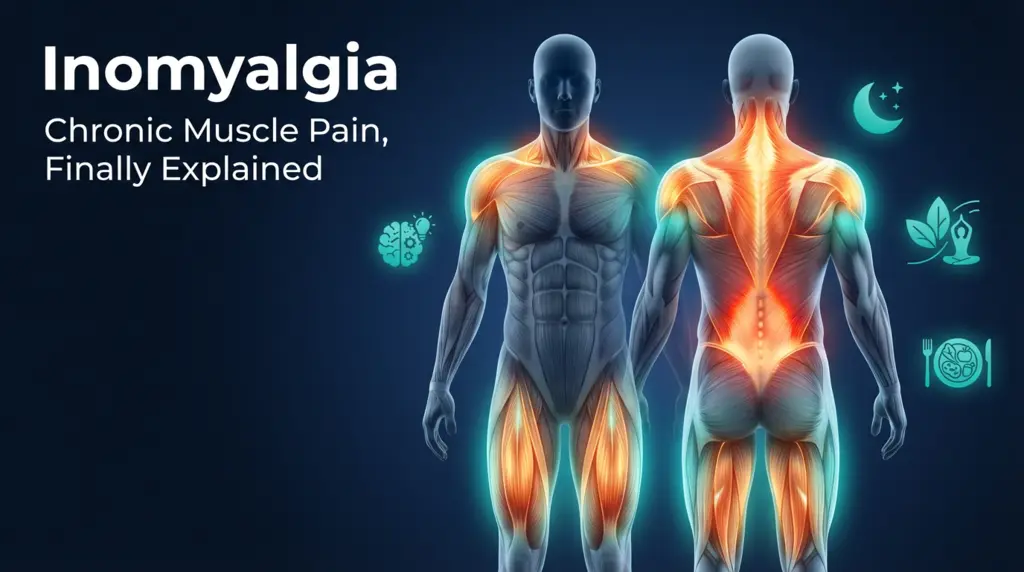
Here’s something most health websites won’t tell you: inomyalgia does not appear in any standard medical dictionary, ICD-11 classification, or clinical diagnostic guide. Yet you searched for it because your muscles ache constantly, rest is not fixing it, and nobody has given you a straight answer. That gap between what you feel and what medicine officially names is exactly what this guide closes. You will walk away knowing what your body is actually experiencing, what doctors call it, and what to do about it starting today.
You have probably read conflicting things online. One site calls inomyalgia a recognized medical condition. Another uses it interchangeably with fibromyalgia. A third writes it off as ordinary soreness. None of them fully explain what you are dealing with. The truth is more useful than any of those versions.
Inomyalgia is built from Greek roots. “Ino” means muscle fiber. “My” means muscle. “Algia” means pain. Literally: pain in the muscle fibers. That description is accurate. The clinical diagnosis that matches it is fibromyalgia. Understanding both terms will put you in control of your next doctor conversation.
Here is the fastest thing you can take from this right now: if your muscle pain has lasted more than three months without a clear injury cause, you are not imagining it. That pattern has a recognized clinical name, established diagnostic criteria, and a treatment path. Keep reading to see where you fit.
What Is Inomyalgia?
Inomyalgia is a descriptive, patient-used term for chronic muscle pain that persists well beyond normal soreness and lacks a single clear cause. It describes muscle fiber discomfort linked to inflammation, nerve sensitivity, hormonal changes, poor sleep, and lifestyle factors. Most people who search for inomyalgia are experiencing what clinicians diagnose as fibromyalgia or a related chronic musculoskeletal pain syndrome.
The word itself is constructed from Greek: “ino” (muscle fiber) + “my” (muscle) + “algia” (pain). It means pain rooted in the muscle fibers. That is a precise description of what fibromyalgia patients report. Both terms point to the same physical experience. The difference is clinical recognition.
Is Inomyalgia a Medically Recognized Condition?
This is where most articles fail you, and it matters for your health.
Inomyalgia is not listed in the ICD-11, DSM-5, or any standard medical classification system used by U.S. physicians. It carries no official diagnosis code. No clinical guidelines exist for it. If you walk into a doctor’s office and say “I have inomyalgia,” many physicians will not recognize the term, and your appointment may stall there.
Here’s what actually works: describe your symptoms specifically. Persistent or widespread muscle pain lasting more than three months, fatigue that does not improve with rest, morning stiffness, and sensitivity to pressure or temperature. That description maps directly onto fibromyalgia criteria set by the American College of Rheumatology.
Fibromyalgia is fully recognized. It has established diagnostic criteria, FDA-approved medications, and a growing body of treatment research. For every practical purpose in this guide, inomyalgia refers to the experience of fibromyalgia-type chronic muscle pain. Knowing this distinction gets you the right care faster.
Symptoms of Inomyalgia You Should Not Dismiss
The core symptom is persistent muscle pain. But inomyalgia-type pain shows up in ways that go far beyond simple soreness.
Commonly reported symptoms include:
- Deep aching, throbbing, or burning muscle pain in the back, shoulders, neck, or legs
- Morning stiffness that takes 30 minutes or more to ease after waking
- Fatigue that persists even after a full night of sleep
- Brain fog, including difficulty concentrating, slow thinking, and memory lapses
- Heightened sensitivity to pressure, cold, or sudden touch
- Disrupted sleep, which worsens pain the following day
- Mood shifts including anxiety and social withdrawal driven by chronic discomfort
Here’s the cycle that traps most sufferers: poor sleep increases pain sensitivity. Increased pain sensitivity disrupts sleep further. That loop is one reason inomyalgia-type pain feels endless without targeted intervention.
Sound familiar? Standard blood tests and imaging scans do not detect fibromyalgia or chronic muscle pain syndromes. Tests come back normal while the pain is very real. Diagnosis is clinical, meaning it is built from your symptom history, not a lab result. This is why many people spend years without answers.
What Causes Inomyalgia?
No single trigger causes inomyalgia. It develops from a combination of factors that disrupt how muscles function, how nerves signal pain, and how the body recovers.
| Cause | How It Contributes to Pain |
|---|---|
| Chronic stress | Keeps muscles in sustained tension, amplifying pain signals |
| Poor sleep quality | Prevents muscle tissue repair cycles from completing |
| Vitamin D, magnesium, or B12 deficiency | Weakens muscle resilience and increases cramping |
| Sedentary lifestyle | Reduces circulation, increasing stiffness and fatigue |
| Hormonal imbalance | Irregular cortisol or serotonin raises pain perception thresholds |
| Post-viral or autoimmune triggers | Inflammation from illness can activate persistent muscle pain |
| Genetic predisposition | Family history of chronic pain raises susceptibility |
The nervous system plays a central role. In many people with chronic muscle pain, the brain’s pain-processing pathways become overly sensitized. Small signals get amplified into significant pain. This process is called central sensitization, and it explains why inomyalgia sufferers often feel pain from pressure or temperature that would not affect most people.
Inomyalgia vs. Fibromyalgia: Key Differences
| Feature | Inomyalgia | Fibromyalgia |
|---|---|---|
| Medical recognition | Informal, descriptive term | Clinically recognized diagnosis |
| Pain distribution | Regional or localized | Typically widespread |
| Diagnostic criteria | None formally defined | ACR criteria established |
| Cognitive symptoms | Mild or absent | Common (fibro fog) |
| Sleep disruption | Moderate | Severe |
| Treatment protocols | Symptom-based | Clinical guidelines available |
| Status | Patient-community term | Listed in ICD-11 and DSM |
Bottom line: if you have been searching for inomyalgia and cannot find a clear clinical path, fibromyalgia is where that path begins. A rheumatologist or pain specialist can assess whether you meet criteria and build a treatment plan based on published evidence.
Proven Treatment Options That Actually Work
Treatment for inomyalgia-type chronic muscle pain works best when it targets multiple contributing factors at the same time.
Medical options:
Physicians may prescribe duloxetine (Cymbalta) or milnacipran (Savella), both FDA-approved for fibromyalgia, which regulate serotonin and norepinephrine levels and reduce central pain sensitivity. Pregabalin (Lyrica) reduces nerve-based pain signaling and has shown consistent results in clinical trials. Over-the-counter NSAIDs like ibuprofen manage acute flare-ups but are not a long-term strategy for chronic muscle pain.
Physical therapy:
Low-impact movement is one of the most evidence-backed interventions for inomyalgia. Swimming, gentle yoga, and 20 to 30 minutes of daily walking improve circulation, reduce stiffness, and gradually rebuild muscular endurance without triggering flare-ups. A licensed physical therapist can build a gradual progression plan specific to your pain locations.
Cognitive Behavioral Therapy (CBT):
CBT does not mean the pain is psychological. Research published in the journal Pain shows CBT significantly reduces pain catastrophizing and improves daily function in chronic musculoskeletal pain patients. It rewires how the brain responds to pain signals, which is especially effective when central sensitization is driving symptoms.
Nutritional support:
Getting vitamin D, magnesium, and omega-3 levels checked is a practical first step. Deficiencies in these nutrients appear disproportionately in chronic pain populations, and correcting them often produces measurable improvement in muscle comfort, energy, and sleep quality within four to six weeks.
Daily Habits That Reduce Flare-Ups
Small, consistent habits outperform large, occasional efforts every time.
- Protect 7 to 9 hours of sleep in a cool, dark room. Sleep quality is the single largest controllable factor in next-day pain sensitivity.
- Apply heat to stiff muscles each morning for 15 minutes before moving. This reduces morning stiffness significantly and improves early mobility.
- Build anti-inflammatory foods into daily meals: leafy greens, berries, fatty fish, turmeric, and nuts. These reduce systemic inflammation that amplifies pain signals.
- Set a movement timer. Every 45 minutes of sitting, stand and gently stretch for 5 minutes. Sustained posture is one of the most overlooked triggers of muscle stiffness.
- Keep a symptom journal. Tracking sleep, food, stress, and pain each day reveals personal patterns most people never notice. The team at Billionscope has a practical guide on identifying and managing chronic pain triggers at billionscope.org.
When to See a Doctor
Do not wait if your muscle pain has persisted beyond six weeks. See a physician right away if pain is accompanied by fever, unexplained weight loss, significant joint swelling, rash, or noticeable muscle weakness. These symptoms point to conditions beyond inomyalgia, including autoimmune disorders, thyroid disease, or inflammatory arthritis, all of which require specific testing.
When you do go, request a referral to a rheumatologist or pain specialist. Bring a written summary of your symptoms, their duration, and any patterns you have identified. Specific documentation leads to faster, more accurate assessment and gets you closer to real treatment.
Frequently Asked Questions
What does inomyalgia mean?
Inomyalgia means pain in the muscle fibers. The word comes from Greek: “ino” for muscle fiber, “my” for muscle, and “algia” for pain. It is a descriptive, informal term used by patients and some health communities to describe chronic, persistent muscle pain that closely mirrors the clinical experience of fibromyalgia.
Is inomyalgia the same as fibromyalgia?
They describe a highly overlapping experience. Inomyalgia is not formally recognized in medical classification systems. Fibromyalgia is the established clinical diagnosis for widespread, chronic muscle and soft tissue pain. Most people searching for inomyalgia are experiencing fibromyalgia-type symptoms and should pursue that diagnostic route.
Can inomyalgia be cured?
There is no universal cure. But many people achieve significant and lasting relief through a personalized combination of medication, physical therapy, CBT, nutritional correction, and improved sleep habits. The goal is reducing pain intensity, breaking the sleep-pain cycle, and restoring daily function.
How is inomyalgia diagnosed?
No blood test exists for inomyalgia or fibromyalgia. A physician assesses your full symptom history, duration, location, and severity, then rules out other conditions. If symptoms meet fibromyalgia criteria from the American College of Rheumatology, that becomes the formal working diagnosis.
What makes inomyalgia worse?
Poor sleep, chronic stress, prolonged inactivity, nutritional deficiencies, and cold temperature exposure are the most commonly reported triggers. Tracking your personal triggers through a daily symptom journal is one of the most effective self-management tools available.
Does inomyalgia affect mental health?
Yes, significantly. Living with chronic, invisible pain that others cannot see often leads to anxiety, social withdrawal, and depression. The pain itself is not psychological, but its impact on mood and relationships is real and deserves direct attention alongside physical treatment.
Key Takeaways
You now know that inomyalgia is a descriptive term for chronic muscle pain that most directly maps to fibromyalgia in a clinical setting. The pain is real. The experience is valid. The confusion around the term does not change what your body is telling you.
Your three immediate action steps: describe your symptoms precisely to a healthcare provider, request a fibromyalgia or chronic pain assessment, and start tracking your sleep and pain patterns this week. These three steps alone accelerate the path from confusion to an actual diagnosis and an actual treatment plan.
Managing inomyalgia-type pain is not about finding one miracle solution. It is about combining the right medical support with consistent sleep hygiene, daily movement, anti-inflammatory nutrition, and stress reduction. Every person’s combination looks slightly different. But the building blocks are consistent across the research.
Book that appointment. Arrive prepared. Your body has been asking for answers long enough.
